
Air Cargo as Strategic Resilience: What South Africa’s Logistics Strategy Teaches Global Supply Chains
South Africa’s air-cargo strategy demonstrates how expanding freight capacity, diversifying airport gateways, and tapping new trade corridors transform logistics resilience into a vital competitive advantage within a fragmented global economy.
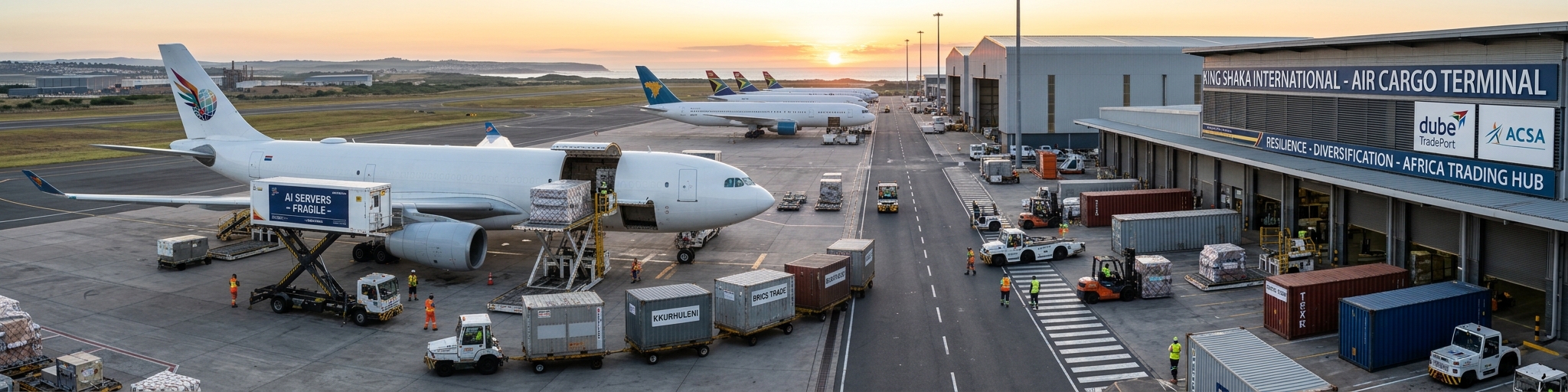
South Africa’s air-cargo strategy matters globally because it shows how countries can turn logistics capacity into resilience as trade becomes more fragmented. By expanding air-freight capacity, diversifying gateways, and building connections beyond traditional corridors, South Africa aims to reduce its exposure to geopolitical shocks, port congestion, and single-point failures.
Global supply-chain impact
Air cargo is becoming a strategic buffer in a world where disruptions are increasingly routine. The article argues that air freight helped businesses absorb tariff shocks, restructure supply chains quickly, and sustain global trade growth of 2.4% and GDP growth of 3.2% despite trade-policy uncertainty.
Its value lies in speed and flexibility. When ocean routes are disrupted by Red Sea security issues, port congestion, conflict, or climate events, air cargo can preserve the flow of high-value, urgent, and time-sensitive goods. During COVID-19, it served as an “air bridge” for medical supplies, pharmaceuticals, and essential goods when other transport modes were constrained.
South Africa’s strategic position
South Africa’s opportunity is to become a more resilient regional logistics gateway rather than depend on one dominant hub. More than 90% of its international air cargo currently moves through Gauteng’s O.R. Tambo International Airport, creating efficiency but also concentrating national risk in a single gateway.
Developing cargo capability at Cape Town International and King Shaka International airports would create redundancy and give exporters alternative routing options during disruption. This is especially important for KwaZulu-Natal, where King Shaka International Airport and Dube TradePort can support time-sensitive exports and regional trade.
Diversification beyond Europe
The article also highlights a broader shift in trade geography. South Africa remains reliant on established European and Middle Eastern air-cargo gateways, while future growth opportunities lie in Southeast Asia, South America, BRICS economies, and African markets connected through the African Continental Free Trade Area.
Expanding routes to these markets is not only about adding destinations. It creates alternative trade pathways that allow businesses to continue operating when traditional corridors face disruption. In a fragmented global economy, that redundancy becomes a competitive advantage rather than an optional investment.
Technology and infrastructure
Air cargo is increasingly critical for high-value technology goods. In 2025, more than two-thirds of global AI-related trade by value moved by air, reflecting the need for rapid, secure movement of servers, memory chips, and data-storage equipment.
For South Africa, capturing this opportunity requires investment in airport cargo infrastructure, cold-chain capacity, cargo-handling technology, and airfreight facilities. These investments would strengthen the country’s ability to serve e-commerce, perishables, pharmaceuticals, and other time-sensitive exports where delivery speed and reliability now determine competitiveness.
Bottom line
The global supply-chain implication is clear: resilience is shifting from a cost center to a source of competitive advantage. South Africa’s air-cargo strategy could reduce dependence on vulnerable corridors, connect African businesses to faster-growing markets, and position the country as a flexible logistics hub in a more fragmented global economy.
Sources https://www.kzntopbusiness.com/post/air-cargo-is-becoming-south-africa-s-strategic-advantage-in-a-fragmenting-global-economy