
Smart Glasses at the Last Mile: Why Amazon’s Delivery Technology Signals a New Era of Supply-Chain Efficiency
Amazon’s deployment of AI-powered smart glasses turns last-mile delivery into a predictable, data-driven operation by giving drivers hands-free navigation, real-time package verification, and seamless operational support directly in their field of view.
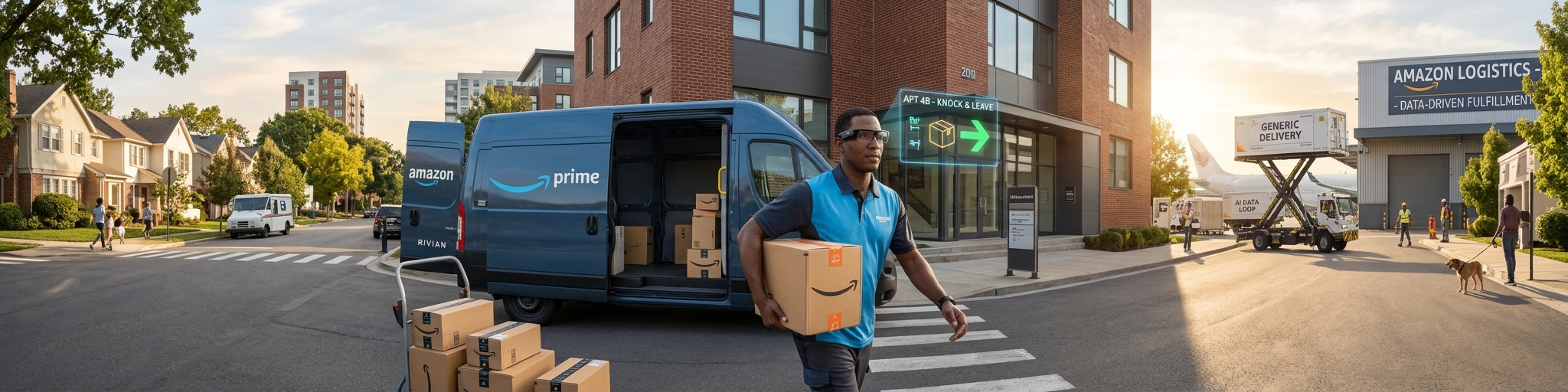
Amazon’s deployment of thousands of AI-powered smart glasses to delivery drivers may appear to be a modest operational upgrade. In reality, it represents a strategic effort to improve the most expensive, variable, and customer-visible part of the supply chain: the last mile. By placing navigation, package verification, delivery preferences, and proof-of-delivery capture directly in a driver’s field of view, Amazon is turning frontline delivery work into a more connected and data-driven process.
The last mile is the efficiency frontier
For decades, supply-chain leaders have focused on optimizing factories, ports, warehouses, and long-haul transportation. These functions have become increasingly automated and measurable. The final delivery leg, however, remains difficult to standardize because it depends on dense urban routes, unclear addresses, customer availability, building access, parking constraints, and human judgment.
Amazon’s smart glasses address that variability at the point of execution. They guide drivers from the moment they stop their van, confirm whether the correct package is aboard, provide turn-by-turn directions, display customer delivery preferences, and automatically capture delivery evidence. The result is not simply a faster driver; it is a more predictable delivery process.
From manual work to augmented work
The most important idea behind this deployment is augmentation, not replacement. The glasses do not remove the driver from the delivery process. Instead, they remove friction from the driver’s workflow.
A driver no longer needs to repeatedly look down at a handheld device to check an address, locate an entrance, review delivery instructions, or take proof-of-delivery photos. The information appears in their field of view, allowing them to keep their attention on the route, the package, and their surroundings.
This creates higher labor productivity because less time is spent searching for information and more stops can be completed during a shift. It also lowers error rates through package verification and wrong-address warnings, while improving safety by helping drivers remain aware of their environment.
Efficiency compounds across the network
The direct benefit is faster and more accurate delivery. The larger benefit is what happens after thousands of deliveries generate structured operational data.
Every delivery interaction can improve Amazon’s understanding of addresses, access points, customer preferences, delivery risks, and route conditions. That feedback loop can enhance mapping, route sequencing, delivery-time estimates, and exception handling across the network.
In supply-chain terms, this creates a self-improving last-mile system. Driver execution generates operational data, which improves algorithms, which in turn improve the next delivery. This is where the technology becomes more than a productivity tool: it becomes an intelligence asset for the entire fulfillment network.
What global supply chains can learn
Amazon’s initiative offers a lesson that extends well beyond parcel delivery. The next major efficiency gains will come from connecting frontline execution to enterprise decision-making.
Many organizations have strong planning systems but weak execution visibility. They can forecast demand, optimize inventory, and schedule transportation, yet still lose margin when warehouse pickers, drivers, field technicians, or store associates lack real-time guidance.
The practical lesson is to put information where the work happens. Rather than requiring workers to search for instructions on separate devices, organizations should deliver contextual guidance at the moment a task is performed. They should also reduce cognitive load by replacing repetitive manual checks with hands-free support, capture data automatically, and design systems that identify exceptions before they become customer-facing failures.
The strategic value of reliability
In global commerce, speed is important, but reliability is often more valuable. A delivery that arrives on time, at the correct address, with the right package, and with clear proof of delivery reduces downstream costs and strengthens customer trust.
Amazon says the glasses are intended to make deliveries safer and more efficient while helping drivers stay focused on their surroundings. That framing matters. Efficiency should not come at the expense of workforce safety or service quality; the strongest supply-chain innovations improve all three.
A new benchmark for frontline technology
Amazon plans to deploy 5,000 glasses this year and more than 20,000 by the end of 2027. The scale matters because it moves the technology beyond a pilot concept and embeds it into a global logistics network.
For supply-chain leaders, the question is no longer whether wearable and AI-assisted tools will enter frontline operations. It is how quickly organizations can redesign workflows around them.
The companies that succeed will not simply buy devices. They will build the operating system around them: clean data, clear workflows, worker trust, privacy safeguards, and measurable outcomes. Amazon’s smart glasses are an early signal that the next competitive advantage in global supply chains may be found not only in warehouses and ports, but in the hands and now on the faces of the people making the final delivery.
Sources: https://www.supplychaindive.com/news/amazon-deploys-thousands-of-smart-glasses-to-delivery-drivers/873620/