
The New Supply-Chain Doctrine: When Geopolitics Rewrites the Rules of Global Trade
Geopolitics has overtaken cost optimization as the primary driver of global trade, forcing leaders to replace single-source supply chains with continuous risk intelligence, strategic flexibility, and resilience.
A Wake-Up Call for Global Operations
The US midterm result is not a return to stability. It is a warning that supply chains now operate in a world where elections, wars, sanctions, tariffs, and energy shocks can rewrite sourcing strategies overnight. Democrats’ control of Congress may restrain some policy extremes, but President Trump retains executive authority over tariffs and trade measures—leaving companies exposed to sudden shifts in the rules of trade.
The era of treating geopolitics as a boardroom footnote is over. For procurement, logistics, manufacturing, and finance leaders, political risk is now operational risk.
Tariffs Remain the Fault Line
The election does not guarantee tariff relief. Trump’s tariffs were moved under Section 301 after the Supreme Court invalidated the earlier emergency-tariff route, preserving a mechanism that allows the administration to act without congressional approval.
That means importers, exporters, and manufacturers must still prepare for higher landed costs, retaliatory measures, supplier switching, and disrupted investment plans. Automotive supply chains show how quickly these pressures become real: US tariffs on Canadian exports have already raised costs and triggered countermeasures, while further tariffs on vehicles and parts remain a stated risk.
Energy, Chokepoints, and the Cost of Conflict
The Middle East conflict has kept oil and gas markets tight, with Brent near $104 per barrel, sending costs through freight networks, factories, warehouses, and consumer prices. Every delayed vessel, rerouted shipment, and fuel surcharge is a reminder that physical security and commercial performance are now inseparable.
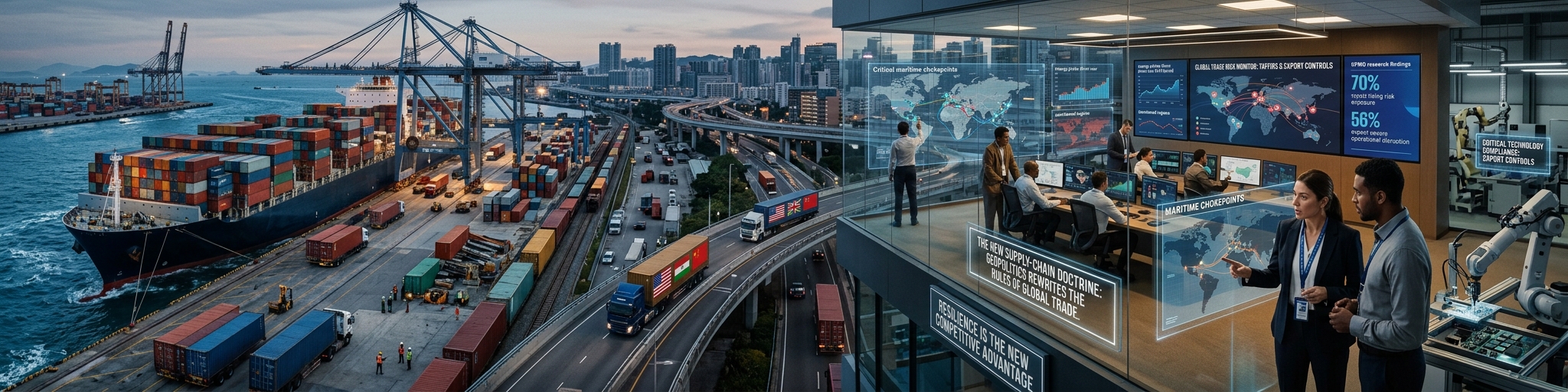
Maritime chokepoints, restricted airspace, damaged refineries, and volatile insurance markets can turn a distant conflict into a local production stoppage. Supply chains are no longer judged only by cost per unit; they are judged by their ability to keep moving under pressure.
Technology Is the New Trade Battlefield
Semiconductors, AI hardware, critical minerals, and dual-use technologies have become strategic assets. Export controls and national-security policies increasingly determine who can buy what, from whom, and where production can take place.
For companies dependent on advanced electronics, cloud infrastructure, automotive systems, or industrial automation, compliance is no longer a legal afterthought. It is a design constraint that shapes supplier choice, inventory strategy, and product roadmaps.
Resilience Is the New Competitive Advantage
The old playbook—lowest cost, longest lead time, single-source dependency—no longer survives contact with geopolitical reality. The OECD defines resilience as the capacity to anticipate, absorb, and adapt to shocks, not merely to avoid them.
Leading companies are shifting from annual supplier reviews to continuous intelligence: monitoring tariffs, sanctions, export controls, port disruptions, energy markets, and the hidden dependencies buried in Tier-2 and Tier-3 suppliers. KPMG research found that 70% of global business leaders report rising risk exposure from geopolitical, energy, cyber, trade, and climate-related disruption, while 56% expect severe operational disruption or material cost impact over the next three to five years.
The Mandate for Leaders
The companies that win the next decade will not be those that predict every crisis. They will be those that build optionality before it is needed: alternative suppliers, regional production capacity, flexible logistics routes, tariff-aware contracts, and scenario-based planning.
The midterm result may change the political tone, but it does not change the fundamental truth: global trade is now contested terrain. Supply-chain leaders must stop asking whether geopolitics will affect their networks and start asking how quickly they can detect, absorb, and adapt when it does.
Source: https://www.euronews.com/2026/11/04/us-midterms-what-trumps-defeat-means-for-europe-and-global-markets