
Predictive Logistics and Global Visibility: The New Foundation for Apparel Supply Chains
As U.S. tariffs reshape apparel sourcing, brands need predictive logistics and end-to-end visibility to anticipate disruptions, model true landed costs, and execute rapid decisions that protect margins and customers.
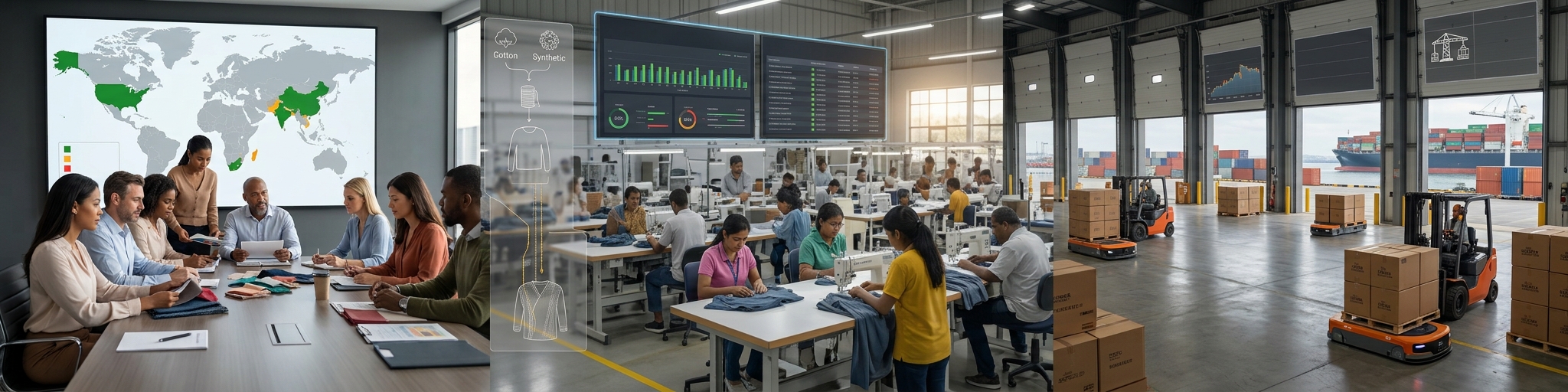
As U.S. tariffs reshape apparel sourcing, global brands and retailers can no longer manage supply chains through annual cost reviews and reactive shipment tracking. They need predictive logistics and end-to-end visibility to see risks early, understand trade-offs, and act before disruption affects customers, margins, and market share.
From cost-driven sourcing to risk-aware sourcing
Tariffs, rules of origin, market access, and trade-policy changes now influence factory selection as much as labor cost and production capacity. A supplier that appears inexpensive on a purchase order can become expensive once duties, longer transit routes, compliance costs, delays, and inventory carrying costs are included.
Predictive logistics gives sourcing and supply-chain teams a way to model these trade-offs before committing orders. By combining tariff exposure, supplier location, material origin, production lead time, freight routing, demand forecasts, and inventory levels, leaders can compare the true landed cost and service risk of each sourcing option.
Seeing the full network
Global visibility is the foundation of predictive logistics. Apparel supply chains are highly fragmented: fibers, fabrics, trims, dyeing and finishing, cut-and-sew capacity, freight forwarders, ports, warehouses, and last-mile delivery often sit across multiple countries and providers.
Without a connected view of these links, a disruption at a fabric mill, port congestion, a customs delay, or a supplier capacity constraint may be discovered only after production or delivery is already at risk. Global visibility changes that by consolidating supplier, production, inventory, shipment, customs, and demand data into one operational picture.
This allows leaders to answer practical questions quickly: Which orders are at risk? Which suppliers or lanes are congested? Where is inventory stranded? Which alternative factory, route, or distribution center can protect the delivery date?
Predicting disruption earlier
Predictive logistics moves organizations from monitoring delays to anticipating them. AI and advanced analytics can identify patterns across weather events, port congestion, labor disruptions, customs processing times, carrier performance, supplier lead times, and demand signals.
For example, if a typhoon threatens a major Asian transshipment hub, predictive systems can flag affected shipments, estimate the delay, simulate alternative routings, and recommend whether to expedite, reroute, airfreight a limited quantity, or reallocate inventory from another region. The decision can be made while alternatives are still available—not after shelves are empty or customer commitments have been missed.
Turning visibility into decisions
Visibility alone does not create resilience. The value comes when data is connected to decision-making.
Leading organizations use predictive insights to prioritize critical orders, identify at-risk inventory, trigger supplier or logistics alternatives, and adjust allocation across markets. They can protect high-margin products, seasonal launches, replenishment programs, and key customer commitments while accepting delay in less urgent categories.
This requires clear decision rights. Supply-chain teams need to know who can approve a reroute, activate an alternative supplier, release safety stock, change a delivery promise, or absorb additional freight cost. Without that clarity, even the best visibility platform can become another dashboard rather than an operational advantage.
Managing tariff-driven complexity
Tariff-driven diversification increases the number of countries, suppliers, routes, and compliance requirements in the network. That makes visibility more important, not less.
A company sourcing from Bangladesh, Vietnam, Cambodia, Indonesia, Pakistan, Sri Lanka, Lesotho, and Madagascar must track different lead times, port capabilities, customs environments, duty structures, and supplier reliability levels. Predictive logistics helps leaders manage this complexity by continuously evaluating cost, transit time, risk exposure, and service performance across the entire network.
It also helps prevent a false sense of resilience. Moving production to multiple countries does not automatically reduce risk if all alternatives depend on the same ports, freight lanes, raw-material suppliers, or trade-policy assumptions. True resilience requires visibility into those shared dependencies.
Protecting customer promise
In apparel, speed and availability are competitive advantages. Fashion cycles are short, demand can shift quickly, and late deliveries can turn into markdowns, lost sales, and damaged brand equity.
Predictive logistics helps protect the customer promise by identifying risks before they become visible to shoppers. It enables earlier intervention, better inventory positioning, more reliable delivery-date commitments, and faster recovery when disruption occurs. The result is not only fewer delays, but better working-capital efficiency, lower markdown risk, and stronger customer trust.
The leadership imperative
For global supply-chain leaders, predictive logistics is no longer a technology project. It is an operating-model change.
Companies need integrated data across sourcing, production, logistics, finance, and sales; AI-enabled forecasting and scenario planning; real-time visibility across suppliers and transport partners; and empowered teams that can act quickly on early warnings. They also need to measure success through outcomes such as time to detect disruption, time to decide, recovery time, on-time delivery, inventory turns, and margin protection.
The organizations that win will not simply diversify their supplier base. They will build a connected, intelligent supply network that can sense change, model alternatives, and execute decisions quickly across a more complex global landscape.
Sources: https://www.coface.com/news-economy-and-insights/who-else-but-china-can-manufacture-our-clothes-impact-of-us-tariffs-on-clothing-industry