
Cargo Surge and Port Congestion: What Rising Far East–Middle East Rates Mean for Global Supply Chains
Surging Far East–Middle East freight rates signal wider global supply chain strain. Discover how port congestion and corridor risks impact worldwide logistics—and how predictive visibility keeps cargo moving.
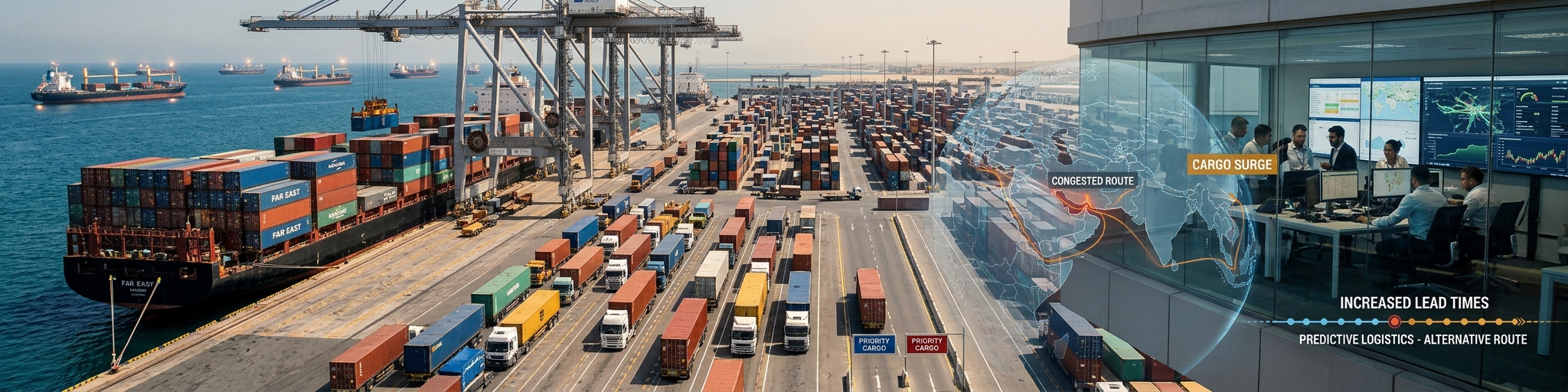
Rising freight rates from the Far East to the Middle East are more than a short-term pricing event. They signal a tighter, more fragile global logistics network in which port congestion, geopolitical risk, capacity constraints, and strong export demand can quickly turn localized disruption into higher costs and longer lead times worldwide.
What is driving the increase
Freight rates from Asia to Gulf economies have climbed sharply as cargo volumes rise and ports in the region face severe congestion. Carriers are adding capacity to capture strong demand, but vessels calling at congested hubs such as Khor Fakkan are experiencing waiting times of more than two weeks to berth.
At the same time, the Middle East remains a fragile transit region. Although some carriers are returning services to the Suez route, uncertainty around the Strait of Hormuz continues to shape routing, capacity deployment, and market expectations.
The result is a classic supply-demand squeeze: strong Far East export volumes, constrained port capacity, longer or more complex routings, and limited ability to absorb additional cargo without delays or higher rates.
The global ripple effect
The first impact is higher freight costs. When Asia–Middle East rates rise, carriers may redeploy vessels toward the more profitable Gulf trade, reducing available capacity on other Asia-bound routes. That can push rates higher across adjacent trades and make contract negotiations more difficult for shippers.
The second impact is longer and less predictable lead times. Port congestion does not only increase waiting time at the destination; it can disrupt vessel schedules, delay downstream connections, create equipment imbalances, and reduce effective network capacity. A delay at one hub can affect shipments bound for Europe, Africa, the Americas, and intra-Asia markets.
The third impact is inventory and service risk. Companies relying on just-in-time replenishment may face stockouts, while those carrying more safety stock face higher working-capital costs. For seasonal or promotional products, even a short delay can mean missed selling windows and markdown pressure.
Why this matters beyond the Gulf
The Middle East is not merely a destination market. It is a strategic logistics corridor connecting Asia with Europe, Africa, and the Indian subcontinent through the Suez Canal, Red Sea, Arabian Gulf, and Strait of Hormuz. Disruption or congestion in this corridor therefore has consequences well beyond Gulf-bound cargo.
The return of services to Suez could eventually ease capacity pressure and shorten transit times, which would put downward pressure on Asia–Europe and Asia–Mediterranean rates. But that recovery remains fragile, and shippers should not assume that normal service patterns will return quickly.
Meanwhile, strong transpacific volumes are adding pressure elsewhere. The Port of Long Beach is expected to handle more than 10 million TEU this year, with strong growth driven partly by import front-loading, concerns over Panama Canal viability, and rising fuel costs. This shows how disruption in one region can amplify congestion and capacity constraints in another
What global leaders should do
Build visibility before volatility
Companies need real-time visibility across purchase orders, supplier production status, container bookings, vessel schedules, port congestion, customs status, and inventory positions. Without this, teams often learn about a delay only after it has already affected downstream plans.
Global visibility should extend beyond direct suppliers to include freight forwarders, carriers, ports, terminals, customs brokers, and distribution centers. The objective is to identify where cargo is, where it is delayed, and what the commercial and operational impact will be.
Use predictive logistics
Predictive logistics helps leaders move from reacting to congestion to planning around it. By combining historical transit performance, port waiting times, weather, carrier schedules, booking data, and demand forecasts, companies can identify high-risk lanes before they become critical.
For example, if a system detects rising berth waiting times at a Gulf transshipment hub, it can flag affected inbound and outbound orders, estimate revised arrival dates, evaluate alternative routings, and prioritize critical inventory. This turns disruption management from a firefighting exercise into a decision-making process.
Diversify routing and capacity
Overreliance on a single port, carrier, alliance, or transit corridor creates vulnerability. Shippers should evaluate alternative gateways, transshipment hubs, inland routings, and carrier options—but diversify with discipline.
The goal is not to move all volume at once. It is to identify critical products and lanes where an alternative routing option is commercially viable, operationally tested, and ready to activate when disruption occurs.
Protect critical inventory
Not every shipment deserves the same response. Companies should segment inventory by revenue contribution, margin, customer criticality, replenishment speed, and seasonality.
Critical items may justify expedited freight, alternative ports, or higher-cost routing. Lower-priority goods can be rerouted, delayed, or consolidated. This prevents companies from paying premium freight rates across the board while still missing service commitments on their most important products.
Negotiate flexibility into contracts
Freight contracts should include more than a fixed rate. Leaders should negotiate capacity commitments, priority loading provisions, flexibility on origin and destination ports, clear service-level expectations, and transparent mechanisms for handling congestion, rerouting, and peak-season surcharges.
Carrier selection also matters. When networks are constrained, the difference between carriers can be measured not only in price, but in schedule reliability, port coverage, transshipment performance, and ability to recover from disruption.
The strategic takeaway
The rise in Far East–Middle East rates is a reminder that global supply chains are increasingly shaped by network dynamics, not individual transactions. A cargo surge in one trade lane, congestion at one port, or geopolitical uncertainty in one corridor can affect costs, capacity, lead times, and service performance across the world.
For global leaders, the response must be proactive: build end-to-end visibility, use predictive analytics to anticipate disruption, diversify critical capacity, segment inventory by business value, and negotiate flexibility before the next disruption arrives. Companies that do this will be better positioned to protect margins, maintain service, and turn volatility into a competitive advantage.
Source: https://theloadstar.com/cargo-surge-and-port-congestion-send-far-east-middle-east-rates-climbing/