
Golden Week Paradox: Congestion-Driven 'Double Sailings' Reshape Transpacific and Asia-Europe Capacity
New analysis reveals record deployed capacity on key trade lanes during Golden Week, as congestion-induced 'double sailings' unexpectedly offset planned blank voyages. This paradoxical surge in capacity, driven by Asian port disruptions, has significant implications for global supply chain flows, costs, and operational resilience.
How this impacts the global supply chain
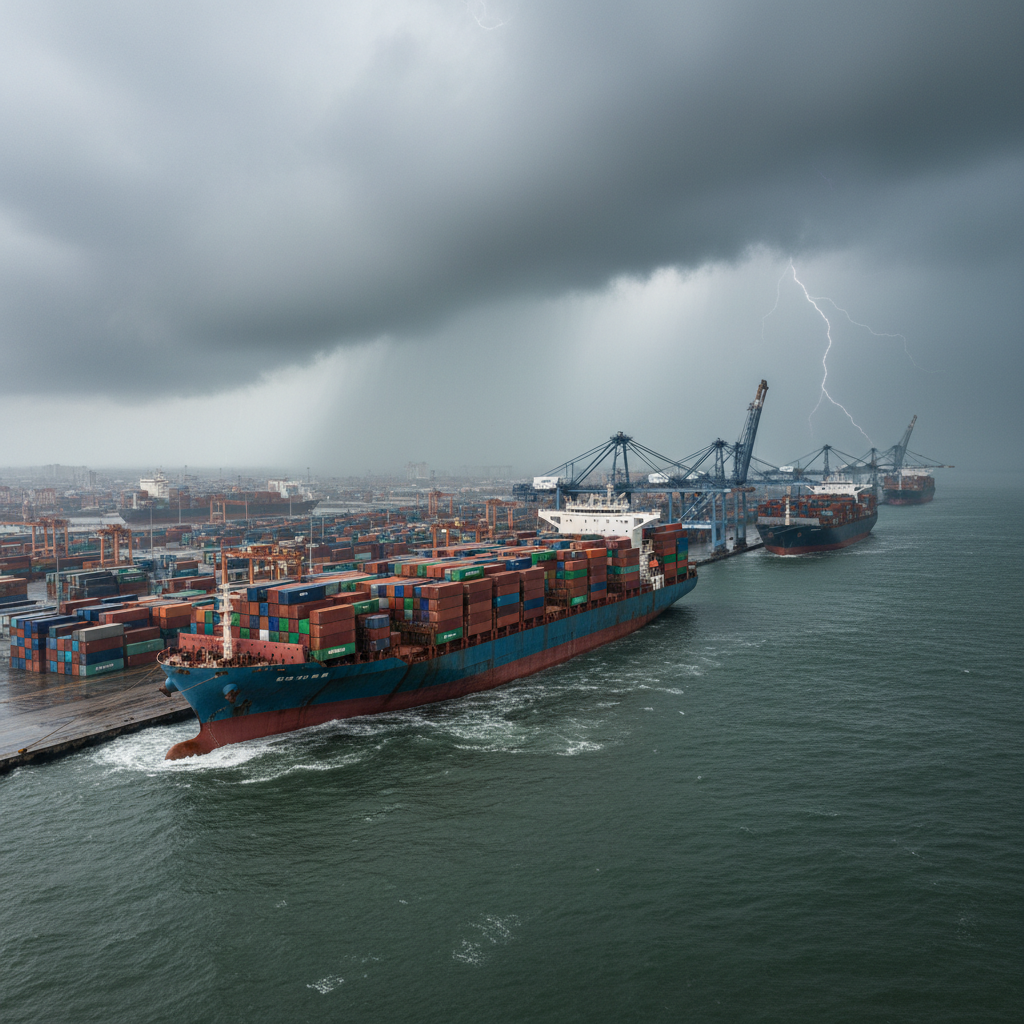
The recent Golden Week period presented a unique paradox in global shipping dynamics, particularly across the transpacific and Asia-Europe trade lanes. Carriers typically leverage this holiday to implement blank sailings, strategically reducing deployed capacity in anticipation of lower manufacturing output and demand from Asian factories. However, this year, severe port congestion in Asia, primarily triggered by a succession of typhoons, fundamentally altered this strategy. Instead of a reduction, the market witnessed record-high deployed capacity, a direct consequence of what has been termed 'double sailings'.
This phenomenon means that while carriers intended to pull vessels from service, the backlog of ships waiting to berth and unload at congested ports forced them to deploy additional, unscheduled sailings to clear the accumulated cargo. These 'double sailings' effectively cancelled out the planned blank sailings, leading to an unprecedented amount of capacity being active on these routes. The immediate impact on supply chain flows is complex: on one hand, more vessels are theoretically available, suggesting greater capacity. On the other hand, this capacity is not flowing smoothly. Vessel bunching at loading ports translates into extended waiting times, delayed departures, and a ripple effect of schedule disruptions across the entire network. This erodes schedule reliability, a critical metric for supply chain planners, and can lead to unpredictable lead times for goods moving from Asia to Western markets. Routes become less predictable, and the operational efficiency of port terminals is further strained by the irregular arrival patterns of vessels.
The consequence for global operations is a heightened state of uncertainty. Shippers face challenges in accurately forecasting arrival times, managing inventory levels, and planning onward distribution. The 'record capacity' is, in essence, a reactive measure to clear a bottleneck, rather than a proactive response to increased demand. This can lead to periods of localized oversupply of vessels at certain ports, while others remain under pressure, creating an uneven distribution of available capacity and exacerbating operational inefficiencies.
Global financial impact
The financial ramifications of this congestion-induced capacity surge are substantial and multifaceted, affecting shippers, carriers, and the broader trade environment. For shippers, the primary impact stems from increased unpredictability and potential delays. Extended transit times due to port congestion can lead to higher inventory holding costs, as goods spend more time in transit or waiting at ports. Furthermore, the erosion of schedule reliability can force shippers to resort to more expensive expedited shipping options or incur penalties for missed delivery windows. Demurrage and detention charges, levied for containers held beyond free time at ports or terminals, are also likely to rise significantly as vessels wait and cargo clearance is delayed. This directly inflates the cost of goods sold and can squeeze profit margins.
Carriers, despite deploying record capacity, are not necessarily reaping financial benefits. The 'double sailings' are a response to operational necessity, not a strategic move to capitalize on higher demand. While more vessels are active, the costs associated with port waiting times, increased fuel consumption due to longer voyages or idling, and potential re-routing can be substantial. Operational inefficiencies, such as slower vessel turnaround times and the need for additional port calls, directly impact their profitability. Although freight rates might remain elevated due to perceived capacity constraints and demand for timely delivery, the underlying operational costs are also likely to be higher, potentially offsetting revenue gains. The overall trade environment suffers from this volatility, as businesses struggle with cost forecasting, supply chain budgeting, and maintaining competitive pricing in a market characterized by unpredictable logistics expenses.
How MGS can help navigate today's global trade environment
In an environment characterized by unexpected capacity shifts and congestion-driven disruptions, a robust shipment-visibility control tower like MGS becomes an indispensable tool for operators. MGS provides real-time, end-to-end visibility into global shipments, offering critical insights that can help mitigate the impacts of phenomena like 'double sailings' and port congestion.
Firstly, MGS can provide granular tracking of vessels and containers, offering precise Estimated Times of Arrival (ETAs) that account for current port conditions and known delays. When typhoons cause congestion and lead to vessel bunching, MGS users receive immediate alerts regarding potential delays at specific Asian ports. This proactive notification allows supply chain managers to adjust their downstream logistics, such as warehouse staffing, onward transportation arrangements, and inventory planning, minimizing the financial impact of unexpected delays. For instance, if a vessel is predicted to be significantly delayed due to congestion, MGS can highlight this, enabling shippers to explore alternative sourcing or re-prioritize other incoming shipments.
Secondly, the platform's predictive analytics capabilities can forecast future congestion points based on historical data, current vessel positions, and weather patterns. This allows operators to anticipate where 'double sailings' might occur or where blank sailings might be effectively negated by operational backlogs. With this foresight, MGS users can evaluate alternative routes or modes of transport, potentially diverting cargo to less congested ports or utilizing different carriers, thereby maintaining schedule integrity and reducing the risk of demurrage and detention charges. The ability to model the impact of different scenarios, such as rerouting options, provides a quantifiable basis for making rapid, informed decisions in a volatile market. MGS acts as a central nervous system for the supply chain, consolidating disparate data points into actionable intelligence, empowering businesses to navigate complex trade environments with greater agility and resilience.
Demand–supply analysis & improvement
This Golden Week scenario presents a fascinating and counter-intuitive demand-supply dynamic. Carriers initially planned for a reduction in supply (blank sailings) to align with an anticipated dip in demand during the holiday period. This is a standard practice aimed at managing capacity and maintaining freight rates. However, the intervention of severe port congestion, exacerbated by typhoons, forced an operational response: 'double sailings'. These were not a result of increased market demand but rather a necessity to clear the backlog of cargo and vessels at choked ports. Consequently, the actual deployed capacity ended up being the highest on record, effectively negating the carriers' intended supply reduction.
This reveals a critical vulnerability in global shipping: planned capacity management can be easily overridden by unforeseen operational disruptions. The 'supply' in this context became a reactive variable, dictated by port fluidity rather than market signals. While the intent was to reduce supply, the outcome was an increase, leading to a paradoxical situation where high deployed capacity coexists with significant operational friction and delays.
Concrete improvement levers emerge from this analysis. Firstly, enhanced port infrastructure and operational efficiency are paramount. Investments in automation, berth optimization, and efficient cargo handling can reduce vessel turnaround times, making ports more resilient to surges and disruptions. Secondly, integrated weather forecasting and predictive analytics are crucial. By incorporating advanced meteorological data into operational planning, carriers and ports can anticipate weather-related disruptions more effectively, allowing for proactive adjustments to vessel schedules rather than reactive 'double sailings'. Thirdly, dynamic capacity management strategies that are more adaptive to real-time port conditions are needed. This involves moving beyond fixed blank sailing schedules to more flexible deployment models that can quickly reallocate capacity or adjust routes based on live congestion data. Finally, improved communication and data sharing between carriers, ports, and shippers can foster better collaborative planning, enabling a more coordinated response to disruptions and preventing the cascading effects of congestion from spiraling out of control.
Source: The Loadstar — https://theloadstar.com/congestion-induced-double-sailings-cancel-out-golden-week-blanks/