
Geopolitical Tides: How Global Events Reshape Cargo Movement and Demand Visibility
Geopolitical events and their cascading effects are fundamentally altering global cargo movement, impacting routes, airspace, and waterways. This brief analyzes the consequences for trade and transport, using a recent shift on the Rhine as a prime example, and highlights the critical role of shipment visibility platforms in navigating these disruptions.
Disruption of Key Waterways and the Shift to Multimodal Solutions
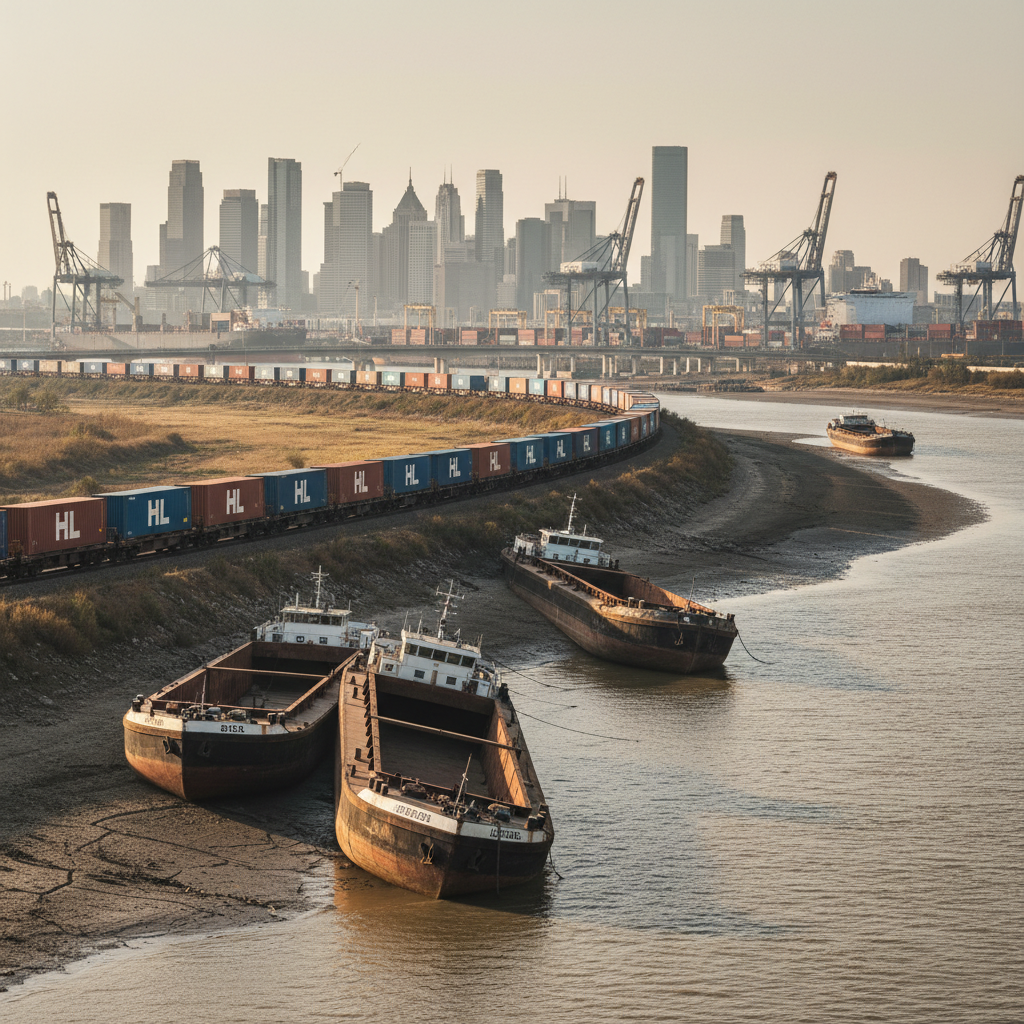
The increasing frequency and severity of disruptions to critical waterways, whether stemming from environmental factors exacerbated by global climate shifts (which carry significant geopolitical implications) or direct geopolitical actions, are forcing a fundamental re-evaluation of established logistics networks. These vital arteries of trade, once considered reliable, are now proving highly susceptible to unforeseen challenges. The recent decision by Hapag-Lloyd to introduce a dedicated weekly rail connection between Rotterdam and Germersheim, operating from 18 September to 31 December 2026, serves as a stark illustration of this vulnerability.
This temporary service addresses critical water levels on the Rhine, a natural phenomenon whose increasing occurrence underscores the fragility of waterway-dependent supply chains. The Rhine, a cornerstone of European inland transport, typically facilitates the smooth flow of goods from major ports like Rotterdam deep into the continent. When its navigability is compromised, the immediate consequence is a scramble for viable alternatives. Hapag-Lloyd's move to rail, providing an alternative to its existing barge network, highlights the immediate need for flexible logistics solutions when traditional routes become unviable. Such shifts inevitably introduce higher operational costs, potentially longer transit times, and necessitate rapid adaptation from carriers and shippers alike. The underlying geopolitical context, ranging from climate policy debates to resource management, further complicates the long-term outlook for such critical infrastructure.
The Ripple Effect on Inland Transport Networks
A disruption in one mode of transport rarely remains isolated; instead, it creates a cascading ripple effect across the entire inland transport network. The diversion of cargo from barges to rail, as seen with the Rotterdam-Germersheim link, immediately places increased demand on rail infrastructure that may not have been designed for such surges. This can lead to congestion at rail terminals, capacity constraints, and potential delays for other rail-bound cargo. Ports, too, feel the pressure as they must adapt to different loading and unloading patterns, potentially requiring new equipment or revised operational procedures to handle increased volumes for alternative modes.
This cascading effect means that a disruption in one segment of the supply chain can quickly propagate, impacting overall network efficiency and reliability. For businesses, this translates into increased lead times, higher freight costs, and the potential for stockouts or production delays. The necessity for proactive planning and dynamic rerouting becomes paramount, as the interdependencies within multimodal networks mean that a single point of failure can compromise broader logistical operations. The ability to pivot swiftly from one transport mode to another is no longer merely an advantage but a fundamental requirement for supply chain resilience in a geopolitically complex and environmentally volatile world.
Geopolitical Pressures on Airspace and Maritime Routes
Beyond environmental factors impacting waterways, direct geopolitical conflicts or heightened tensions frequently lead to the closure of critical airspaces or the re-routing of established maritime lanes. Such actions, often implemented without prior warning, can instantaneously disrupt global trade flows. Air cargo, typically relied upon for its speed and reliability, faces significant challenges when major flight corridors become inaccessible, forcing aircraft to take longer, more circuitous routes. This not only extends transit times but also escalates fuel consumption and operational costs, ultimately impacting the final price of goods.
Similarly, maritime routes are vulnerable to geopolitical instability. Areas prone to conflict or piracy necessitate extensive detours, adding thousands of nautical miles and days or even weeks to voyages. Increased security measures and insurance premiums further compound the financial burden on shipping lines and, by extension, on consumers. These diversions, whether by air or sea, directly impact delivery schedules, inventory management strategies, and the predictability of global supply chains, pushing companies to seek more resilient, albeit often more expensive, alternatives.
Tariffs, Sanctions, and Trade Flow Reconfiguration
Tariffs and sanctions, often deployed as instruments of geopolitical strategy, fundamentally alter the economic viability of traditional trade relationships and routes. These governmental interventions can render previously cost-effective sourcing locations prohibitively expensive or entirely inaccessible. Companies are compelled to re-evaluate their entire supply chain architecture, seeking new suppliers in unaffected regions or developing entirely new distribution channels to circumvent restrictions.
This reconfiguration is not a swift process. It involves significant investment in new relationships, compliance auditing, and logistical adjustments. The imposition of tariffs can lead to increased import costs, which are typically passed on to consumers or absorbed by businesses, impacting profitability. Sanctions, on the other hand, can sever access to critical markets or essential components, forcing companies to onshore production or find alternative, often less efficient, supply sources. The net effect is a fragmentation of global trade flows, the emergence of new trade corridors, and an overall increase in the complexity and cost of international commerce, demanding constant vigilance and strategic adaptation from supply chain leaders.
Enhancing Resilience Through Shipment Visibility
In this increasingly volatile landscape, a robust shipment-visibility control tower platform like MGS becomes an indispensable asset for navigating geopolitical and environmental disruptions. By providing real-time, end-to-end visibility across all modes of transport – from ocean vessels and barges to rail and road – MGS empowers logistics professionals to anticipate and react swiftly to disruptions.
For instance, in a scenario like the Rhine's critical water levels, an MGS platform would immediately flag potential delays for barge traffic, allowing for proactive planning. It could identify available rail capacity, facilitate the booking of alternative routes like the Rotterdam-Germersheim connection, and track the diverted cargo's progress seamlessly. When airspace is closed or maritime routes are rerouted due to geopolitical events, MGS provides the immediate intelligence needed to assess the impact on specific shipments, calculate new estimated times of arrival, and communicate effectively with all stakeholders.
This granular level of insight enables dynamic rerouting, optimizes inventory levels to mitigate delays, and helps manage customer expectations effectively. The ability to track cargo precisely, understand potential bottlenecks, and model alternative scenarios in real-time is no longer a luxury but a strategic imperative for maintaining supply chain continuity and competitive advantage in a world where geopolitical events and environmental challenges are consistently reshaping the logistics landscape.
Source: Container News — https://container-news.com/hapag-lloyd-adds-rotterdam-germersheim-rail-connection/