
Geopolitical Currents: Navigating New Fees and Restrictions on Spanish Shipping
The recent FMC proposal to impose significant fees and import restrictions on Spanish-flagged vessels underscores the escalating impact of geopolitical events on global trade. This brief examines the direct consequences for cargo movement, costs, and supply chain resilience.
Introduction
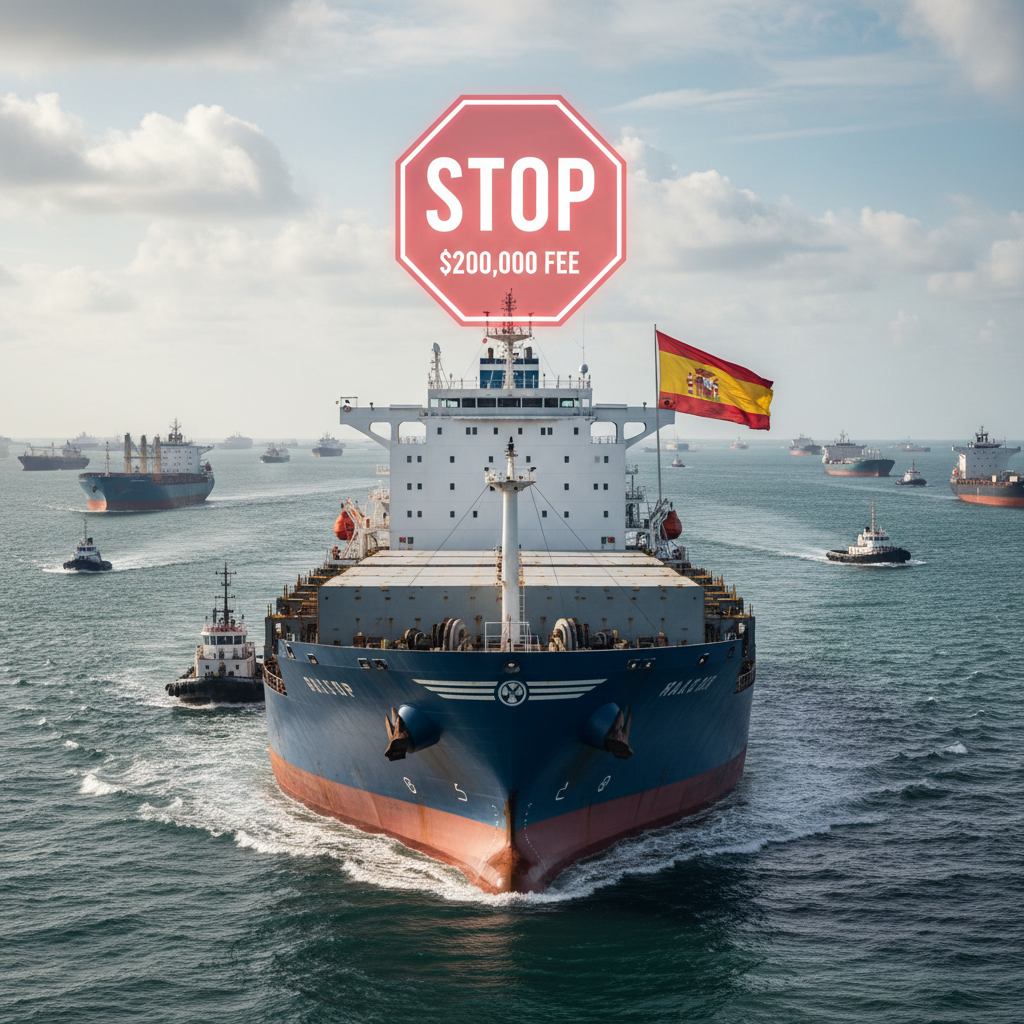
The global supply chain landscape is perpetually shaped by geopolitical forces, with recent developments serving as potent reminders of their immediate and far-reaching consequences. The Federal Maritime Commission's (FMC) recent proposal to levy a $200,000 per-voyage fee on Spanish-flagged vessels, coupled with restrictions on certain goods originating from Spain, exemplifies how regulatory actions, often stemming from broader political contexts, directly translate into tangible disruptions for cargo movement, trade routes, and operational costs. For supply chain professionals, these events are not abstract political headlines but concrete challenges demanding immediate strategic adjustments and robust visibility. This brief analyzes the direct implications of such measures on trade and transport, highlighting the critical need for adaptability and data-driven decision-making in an increasingly volatile global environment.
Direct Impact on Shipping Costs and Carrier Selection
The imposition of a substantial $200,000 per-voyage fee on Spanish-flagged vessels represents a significant new operational cost for carriers. Such a hefty surcharge cannot be easily absorbed, leading to an inevitable pass-through to shippers in the form of higher freight rates for goods transported on these vessels. This directly impacts the competitiveness of Spanish-flagged carriers and, by extension, the cost structure for any company utilizing their services. Shippers will be compelled to re-evaluate their carrier partnerships, potentially shifting demand towards non-Spanish flagged vessels or exploring alternative shipping lines that are not subject to these new fees. This dynamic could lead to a reallocation of cargo volumes across different carriers and routes, altering established shipping patterns and potentially creating capacity imbalances elsewhere. For an MGS shipment-visibility control tower, this scenario immediately triggers alerts for affected shipments, allowing for real-time calculation of increased costs and identification of alternative, more cost-effective carrier options or routes to mitigate financial impact.
Trade Flow Disruptions and Diversification
Beyond direct shipping costs, the proposed restriction on "certain goods" originating from Spain introduces a significant impediment to established trade flows. Importers who rely on these specific product categories from Spain will face immediate supply shortages or a complete cessation of supply from that source. This necessitates a rapid and often costly search for alternative suppliers in other countries, forcing a diversification of sourcing strategies. Conversely, Spanish exporters of these restricted goods will lose access to a key market, compelling them to seek new export destinations or face reduced demand. Such shifts in sourcing and market access inevitably lead to changes in global trade lanes, potentially increasing demand for shipping capacity on new routes and altering the balance of freight rates. An MGS platform becomes invaluable here, offering the ability to quickly identify which specific goods and associated shipments are impacted, and to map out potential alternative sourcing locations, providing crucial data to re-engineer supply chains under duress.
Port Congestion and Route Changes
The financial disincentive of a $200,000 fee could prompt Spanish-flagged vessels to reconsider their port calls or even their entire routing strategies. If these vessels opt to avoid ports where the fee is enforced, it could lead to a reduction in traffic at those specific locations, potentially impacting port revenues and operational efficiency. Conversely, if vessels reroute to alternative ports or regions to circumvent the fees, those new destinations could experience an unexpected surge in traffic. This sudden influx of vessels can quickly lead to increased port congestion, longer dwell times for cargo, and significant delays in onward transportation. Such rerouting also lengthens transit times and increases fuel consumption, impacting overall supply chain efficiency and environmental footprint. A robust MGS control tower can provide real-time tracking of vessel movements, detect deviations from planned routes, and predict potential congestion at alternative ports, enabling shippers to proactively adjust their logistics schedules and minimize delays.
Supply Chain Resilience and Risk Management
This incident serves as a stark illustration of the inherent vulnerabilities within global supply chains when exposed to geopolitical actions. Companies that have concentrated their sourcing, manufacturing, or shipping operations through a single country, flag state, or specific trade lane are particularly susceptible to such disruptions. The need for enhanced supply chain resilience becomes paramount, emphasizing strategies such as multi-sourcing, geographical diversification of suppliers and logistics partners, and the development of flexible logistics contracts. Proactive risk management, including scenario planning for various geopolitical eventualities, is no longer a luxury but a fundamental requirement. An MGS shipment-visibility control tower plays a crucial role in building this resilience by offering end-to-end transparency, allowing businesses to identify single points of failure, assess the real-time impact of disruptions, and rapidly evaluate the effectiveness of contingency plans, transforming reactive responses into proactive risk mitigation.
Impact on Global Trade Relations from a Transport Perspective
While the underlying political motivations are beyond the scope of this analysis, the transport implications of such measures are clear. Unilateral actions like imposing fees or restricting goods can trigger reciprocal measures from affected nations, leading to a complex web of retaliatory tariffs, fees, and restrictions. This creates an increasingly fragmented and unpredictable operating environment for international shipping. Carriers and shippers must navigate a growing patchwork of rules that can vary significantly based on the vessel's flag, cargo origin, destination, and even specific product categories. This escalating complexity increases administrative burdens, compliance costs, and operational uncertainty across the global logistics network. It ultimately undermines the efficiency and reliability of international trade, making global supply chains more costly and less agile. An MGS platform can help by integrating and visualizing complex data on evolving trade regulations, sanctions, and tariffs, providing a consolidated, real-time view of compliance requirements and potential impacts on planned shipments.
Conclusion
The proposed fees and import restrictions on Spanish-flagged vessels and goods are a powerful testament to the direct and often immediate impact of geopolitical events on global cargo movement. From increased shipping costs and altered trade flows to potential port congestion and the urgent need for supply chain diversification, the consequences for trade and transport are profound. In this increasingly complex and volatile environment, the ability to maintain real-time, end-to-end visibility across the supply chain is no longer merely an advantage but a fundamental necessity. Platforms like MGS provide the critical intelligence needed to anticipate disruptions, adapt strategies, and ensure the continuous, albeit sometimes rerouted or more costly, flow of goods across international borders.
Source: Supply Chain Dive — https://www.supplychaindive.com/news/fmc-proposes-fees-on-spanish-flagged-vessels-import-restrictions/833122/