
2026 CNBC Disruptor 50 Indication - How MG Ship Is Building the AI Intelligence Layer for Global Trade
MG Ship is building the AI intelligence layer for global trade, helping businesses anticipate supply chain disruptions, optimize routes and carriers, and turn complex logistics data into measurable financial outcomes.
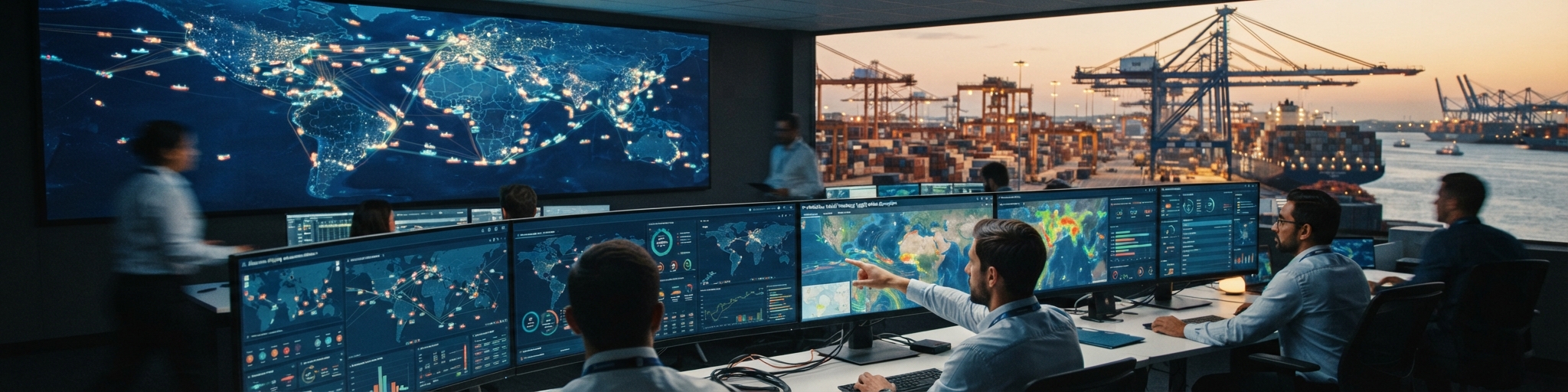
Global trade has become too complex to manage with spreadsheets, static dashboards, and reactive decision-making. Ports congest, weather disrupts schedules, carriers perform unevenly across lanes, and customs delays can cascade into inventory shortages, lost sales, and higher freight costs. MG Ship is building the AI intelligence layer for this reality, helping shippers, retailers, manufacturers, and logistics providers see risk earlier, choose better routes and carriers, and turn supply-chain data into measurable financial outcomes.
AI must create business outcomes
The next phase of enterprise AI will not be defined by impressive demonstrations. It will be defined by systems that help organisations make better decisions, act faster, and produce results they can measure. 2026 CNBC Disruptor 50 list reflects this shift: Anthropic ranked No. 1, while 43 of the 50 companies identified AI as critical to their business model. Enterprise technology was the largest category, with 20 companies, showing that AI is increasingly being built for organisations that need reliability, integration, and measurable value.
Anthropic’s position at the top of the list illustrates why investors are paying attention to AI companies with credible enterprise adoption. CNBC reported that Anthropic’s revenue grew 80 times in the first quarter and that the company was reportedly in discussions to raise capital at a valuation of as much as $900 billion.
The lesson for the broader market is not that every AI company should be valued like Anthropic. It is that investors increasingly reward AI platforms that solve important business problems, gain enterprise trust, and demonstrate a path to scalable adoption. MG Ship is applying that principle to one of the world’s most operationally complex and financially consequential industries: global logistics.
The real opportunity in logistics
Logistics has traditionally been treated as a cost centre: a necessary function to move goods from origin to destination. But in a global economy shaped by disruption, volatility, and rising customer expectations, logistics can determine whether a company protects margin, retains customers, and captures demand.
MG Ship believes the opportunity lies in moving beyond visibility. Knowing where a shipment is located is useful, but it is not enough. Businesses need to understand what is likely to happen next, what it will cost, and what action they should take before disruption affects revenue, working capital, or customer promise.
This is where MG Ship’s platform creates value. By combining real-time shipment visibility, predictive analytics, trade intelligence, and AI-driven recommendations, the company helps decision-makers move from hindsight to foresight. Its new route-optimisation and carrier-recommendation module, unveiled at WMX Asia, is designed to help businesses choose the fastest, most reliable, and most cost-effective path for every shipment.
From data to decisions
MG Ship’s approach is built around a simple but powerful idea: logistics data should lead to a decision, not simply another report. The platform analyses live and historical lane performance, weather signals, port and airport congestion indicators, customs-risk signals, and transit-reliability estimates to recommend optimal routing across global trade corridors.
Carrier selection is equally important. Freight rate alone does not reveal the true cost of a logistics decision. A lower headline rate can become expensive if it leads to delays, missed connections, higher exception handling, or poor inventory availability. MG Ship ranks carriers by lane and service level using on-time performance, transit consistency, exception frequency, claims history, capacity availability, and total cost to serve.
The platform also enables scenario planning. Logistics teams can model alternative routings, carrier allocations, and sourcing strategies before peak seasons or major promotional campaigns. Instead of reacting after disruption occurs, they can quantify the likely impact on lead times, costs, service levels, and supply-chain risk before committing spend.
Measurable ROI, not theoretical value
The strongest AI investments are those that can be connected directly to financial performance. MG Ship is designed around that standard. Industry examples cited by the company indicate that dynamic route optimisation can reduce fuel consumption by 15% to 20%, improve delivery speed by 15% to 25%, and lower transportation and operating costs by roughly 12% to 22%, with many projects achieving payback within three to six months.
For customers, this can translate into lower premium freight and expedite spend, reduced lead-time variability, stronger on-time-in-full performance, more accurate inventory planning, improved product availability, and better working-capital efficiency. These are not abstract technology benefits. They affect revenue, margin, cash flow, and customer experience.
Why investors should pay attention
MG Ship is positioned at the intersection of two powerful trends: the enterprise adoption of AI and the growing need for resilient, intelligent global supply chains. Its platform is designed to produce operational outcomes rather than simply display information, giving it a clear path to customer value and commercial relevance.
The company’s opportunity is strengthened by its potential to expand across the logistics value chain. Route optimisation and carrier recommendations can serve as the foundation for broader capabilities in predictive analytics, risk monitoring, trade-finance intelligence, and decision support. As more shipments, lanes, carriers, and disruption events are analysed, the platform can become more valuable in predicting performance and recommending better decisions.
This is the kind of AI application that matters: not AI for its own sake, but AI that helps a retailer protect product availability, a manufacturer avoid production disruption, a logistics provider improve service reliability, and a finance team make more informed working-capital decisions.
The future of intelligent trade
The companies that win in the AI era will be those that embed intelligence directly into the workflows where value is created. In global trade, that means helping businesses anticipate disruption, allocate capacity intelligently, select the right partners, and protect both service performance and margin.
MG Ship’s vision is to make that capability accessible across the supply chain. By turning complex logistics data into clear, actionable insight, the company is helping businesses move from managing problems after they occur to preventing them before they affect the bottom line. Leading organisations are already using AI to reduce transportation costs, improve forecast accuracy, increase warehouse productivity, and achieve payback in months rather than years. MG Ship is building for that future.
To learn more, visit www.mglobalship.com or contact enquiry@mglobalship.com.
MG Ship - Track. Analyse. Turn Insight into Action.
Source: https://www.cnbc.com/2026/05/19/2026-cnbc-disruptor-50-rankings-anthropic-no-1.html