
MG Ship Launches AI System to Find Faster, Cheaper and Lower-Risk Shipping Routes
Logistics technology company MG Ship has introduced a new AI-powered route optimization and carrier recommendation module designed to help retailers, manufacturers, freight operators, and global shippers choose better transportation routes and carriers across international trade corridors.
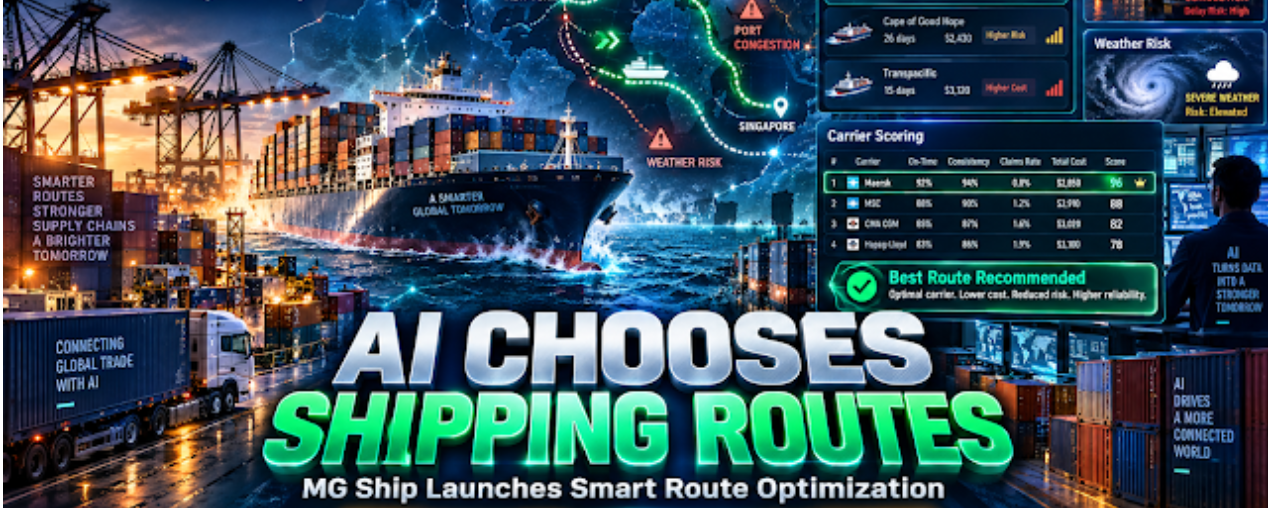
Artificial intelligence is moving deeper into global logistics, and this time it is helping decide not only where cargo is, but how it should travel.
Logistics technology company MG Ship has introduced a new AI-powered route optimization and carrier recommendation module designed to help retailers, manufacturers, freight operators, and global shippers choose better transportation routes and carriers across international trade corridors.
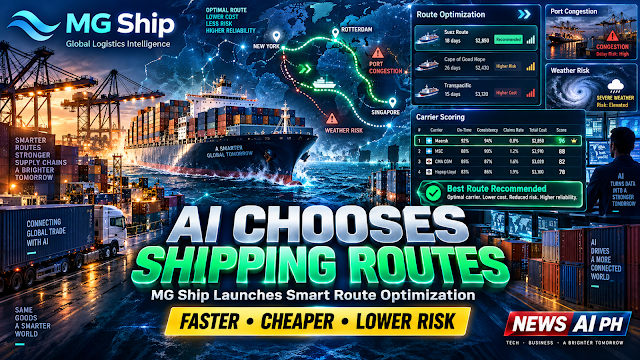 The system analyzes changing logistics conditions including weather disruptions, port and airport congestion, customs risks, historical transit performance, and carrier reliability.
Instead of simply displaying the location of a shipment, MG Ship says the platform can recommend the fastest, most reliable, most cost-effective, and lowest-risk shipping option available at a given time.
That represents an important shift in logistics technology.
Traditional tracking systems answer:
Where is my cargo?
AI-powered supply chain systems are increasingly being asked a much more valuable question:
What should we do next?
AI Chooses the Route MG Ship's dynamic route optimization engine combines historical and real-time data to evaluate different transportation paths.
The system considers factors including:
weather conditions,
port congestion,
airport disruptions,
customs risk,
lane performance,
and expected transit reliability.
It can then recommend alternative routes based on cost, speed, reliability, and operational risk.
For companies shipping thousands of containers, parcels, components, or retail products around the world, even small improvements in routing can have large financial consequences.
A delayed shipment can create inventory shortages.
A missed connection can require expensive expedited freight.
A congested port can disrupt an entire supply chain.
And selecting the cheapest carrier does not always produce the lowest total cost.
That is where MG Ship says AI can help.
AI Can Also Choose the Carrier The platform does not evaluate routes alone.
MG Ship has also added carrier selection and performance scoring.
Instead of choosing transportation providers primarily according to freight price, the system can evaluate carriers using several measures, including:
on-time performance,
transit consistency,
exception frequency,
claims history,
available capacity,
service level,
and total cost-to-serve.
The AI can then rank carriers according to the requirements of a particular shipment or trade lane.
That means a company could discover that the carrier offering the cheapest quoted rate is actually more expensive after delays, claims, failed service levels, or emergency shipping costs are included.
AI can potentially expose that difference before the shipment is assigned.
Companies Can Simulate Shipping Decisions Before Making Them Another feature allows logistics teams to perform scenario planning.
Before peak seasons, major sales campaigns, or changes in sourcing strategy, companies can simulate different combinations of:
routes,
carriers,
shipping allocations,
lead times,
freight costs,
service levels,
and supply chain risks.
The system can estimate how those decisions might affect overall logistics performance before companies commit cargo and money.
MG Ship says early implementations indicate improvements including lower lead-time variability, reduced premium freight spending, improved on-time-in-full delivery performance, and stronger inventory planning. These are company-reported early observations rather than independently audited performance results.
AI in Logistics Is Starting to Show ROI The larger story is that logistics companies are increasingly moving artificial intelligence beyond pilot projects.
MG Ship's September announcement cites research and industry case studies showing some of the fastest AI returns appearing in three major areas.
Route Optimization According to figures cited by MG Ship, dynamic route optimization has helped some companies achieve:
15 to 20 percent lower fuel consumption
15 to 25 percent faster deliveries
12 to 22 percent lower transportation costs
and 12 to 20 percent lower operating costs.
The company says some projects have reached payback within approximately three to six months.
AI Demand Forecasting AI-powered forecasting has reportedly helped reduce forecast errors by approximately 20 to 40 percent, while improving forecasting accuracy by as much as 35 percent.
Some deployments have also reduced inventory levels by around 20 to 30 percent, with measurable benefits typically appearing within six to twelve months, according to the figures cited by MG Ship.
Automated Freight Documents Artificial intelligence is also being used on one of logistics' least glamorous but most time-consuming problems:
paperwork.
MG Ship cited industry cases where freight-document automation reduced manual processing time by as much as 85 percent, with some systems reaching return on investment within three to six months.
Across early AI adopters, the announcement cites logistics and operational cost reductions of roughly 10 to 25 percent and warehouse productivity gains of approximately 25 to 35 percent over longer deployment cycles.
Again, these figures represent industry research and cases cited by MG Ship, not a blanket guarantee that every company implementing AI will achieve the same results.
From Tracking Cargo to Predicting What Happens Next MG Ship's broader platform already combines real-time shipment visibility with predictive analytics, trade intelligence, and risk monitoring.
The idea is to move supply-chain software from observation toward recommendation.
Tracking systems tell managers that a container has been delayed.
Predictive systems may warn that the container is likely to be delayed.
Decision systems go another step and recommend what the company should do about it.
That progression is significant.
The next generation of enterprise AI may not simply generate text, images, or reports.
It will increasingly recommend operational decisions involving money, inventory, transportation, risk, and physical assets.
AI Beyond the Hype at WMX Asia MG Ship CEO Suki Cheung is scheduled to discuss AI's practical impact on logistics at WMX Asia 2026, being held at the Kerry Hotel in Hong Kong from September 15 to 17.
The official WMX Asia agenda lists Cheung alongside Charles Brewer of Pos Malaysia, Sintija Bērziņa of Omniva, and George Tabakian of OnyX Space for a September 17 session examining AI and technology in logistics.
The discussion will cover route optimization, warehouse technology, workforce changes, AI-powered supply chain visibility, and the measurable results companies are already seeing from deployment.
Cheung argues that too much discussion around logistics AI still focuses on what might happen in the future.
But the industry is increasingly asking a more practical question:
Does the AI actually save money?
That may ultimately determine which technologies survive the current AI boom.
What This Means for the Philippines This story has particular relevance to the Philippines.
We are an archipelagic economy dependent on a complicated network of:
ports,
airports,
trucking,
shipping lines,
warehouses,
distribution centers,
couriers,
and inter-island transportation.
A shipment from Metro Manila to Cebu, Davao, Iloilo, Bataan, or a remote municipality may require several transportation modes before reaching its destination.
Now imagine an AI system continuously analyzing:
weather,
port congestion,
shipping schedules,
fuel costs,
customs conditions,
carrier reliability,
warehouse inventory,
delivery deadlines,
and transportation prices.
Instead of simply telling a Philippine business that a shipment is delayed, the system could recommend:
Move it through another port.
Change the carrier.
Use air freight for this portion.
Delay this shipment but prioritize another.
Move inventory from another warehouse.
That is where AI becomes much more than a chatbot.
It becomes part of the country's economic infrastructure.
For Philippine retailers, manufacturers, exporters, importers, e-commerce companies, freight forwarders, and logistics providers, this could become a major competitive advantage.
But there is another lesson here.
The companies that benefit most from AI will not necessarily be those that simply purchase the newest software.
They will be those with the best data, operational discipline, digital infrastructure, and ability to act on AI recommendations.
Because knowing the best route means very little if your organization cannot actually change course.
The real AI revolution in logistics is therefore not simply about knowing where the cargo is.
It is about knowing:
where it should go,
who should carry it,
what it will cost,
what could go wrong,
and eventually,
what decision should be made next.
That is artificial intelligence moving from prediction into real-world decision-making.