
When Typhoon Recovery Becomes the Real Risk: How MG Ship’s Predictive AI Stabilises Global Supply Chains
MG Ship’s AI platform provides predictive route optimization and carrier intelligence, helping supply chain leaders navigate typhoon-related port backlogs, minimize disruption costs, and build long-term operational resilience.
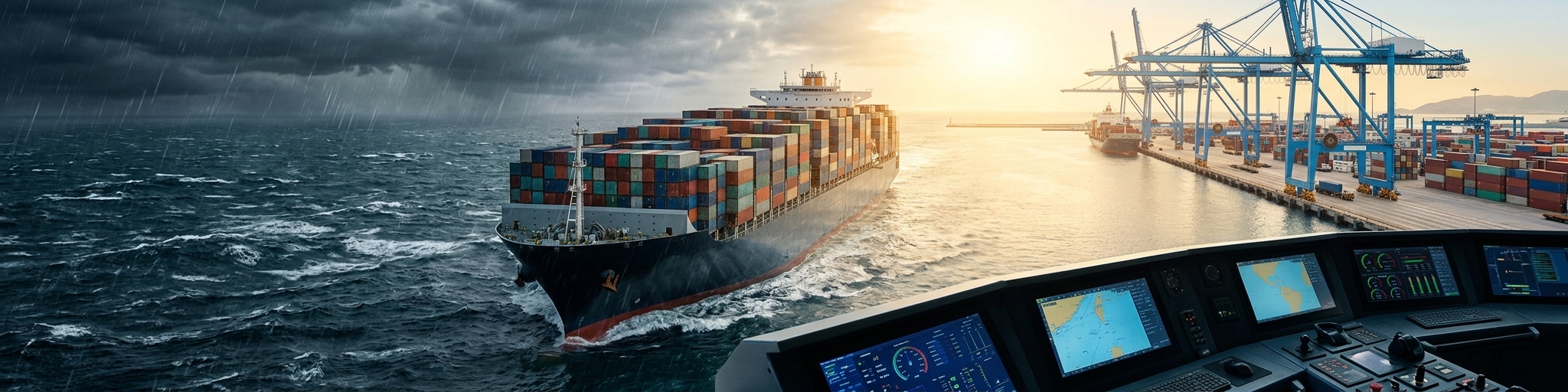
Typhoon season has always been a “known unknown” for supply chains. Historically, the risk window was clear: ports might close for 24–72 hours, vessels would be delayed, trucking disrupted, and then - once the weather cleared, operations would return to normal within days.
That assumption no longer holds.
Recent disruptions in East China show how a short weather event can trigger weeks of operational fallout. Although port closures lasted only a few days, the resulting backlog required several weeks to unwind. Vessel queues stretched to 7–10 days, terminal yard utilization approached 90-95%, and more than 4 million TEU of cargo accumulated across major North Asia ports. Delays persisted long after ports officially reopened.
For shippers, this shifts the core risk question from “How strong is the storm?” to “How quickly can the supply chain recover?” A 48-hour closure can now create two to three weeks of disrupted vessel schedules, mounting detention/demurrage/storage costs, constrained container availability, missed delivery commitments, and inventory imbalances across markets. These indirect costs often exceed the direct impact of the weather event itself.
The effects also ripple globally. When vessels depart East China behind schedule, transshipment hubs such as Singapore, Hong Kong, Shenzhen, and Port Klang face secondary congestion, while downstream ports in Europe and North America deal with missed connections and irregular arrivals. A local storm becomes a global supply chain challenge.
From Visibility to Action: How MG Ship’s Predictive AI Turns Data into Decisions
In this environment, weather forecasts and static dashboards are no longer enough. Shippers need a platform that not only shows what is happening, but recommends what to do next, and quantifies the impact of each option. MG Ship delivers exactly that by combining real-time logistics visibility with predictive AI for route optimisation and carrier performance management.
Intelligent Route Recommendations That Anticipate Congestion
MG Ship’s AI engine continuously ingests live data on port congestion, vessel waiting times, terminal yard utilization, inland transport constraints, and historical recovery patterns. Instead of simply displaying anchorage backlogs, the platform simulates multiple routing scenarios and recommends the optimal path for each shipment based on business priorities such as cost, transit time, reliability, and inventory exposure.
This capability is critical when delays are no longer confined to East China. As backlogs propagate through transshipment hubs like Singapore, Hong Kong, and Port Klang, MG Ship’s predictive models forecast downstream impacts on Europe and North America, allowing shippers to adjust plans proactively rather than reactively.
Carrier Performance Intelligence for Smarter Allocation
Not all carriers recover from disruptions at the same pace. MG Ship tracks carrier-specific performance metrics, including schedule reliability, port omission frequency, average delay per lane, and recovery time after disruptions to help shippers allocate cargo to the most resilient partners.
During the recent East China congestion, carriers that omitted Shanghai or Ningbo calls and diverted to alternative ports were able to maintain better schedule integrity. MG Ship identifies these patterns in real time and recommends carrier adjustments based on actual performance rather than contractual preferences alone. Over time, this intelligence enables shippers to build a dynamic carrier scorecard that evolves with market conditions, reducing exposure to underperforming lanes and improving overall network reliability.
Predictive AI That Turns Instability into Advantage
The true power of MG Ship lies in its ability to transform volatility into a strategic advantage. By modeling “what-if” scenarios, such as a typhoon hitting during peak season, a port closure lasting 72 hours, or a carrier omitting a key transshipment hub, shippers can stress-test their supply chains and pre-position inventory, diversify sourcing, or adjust routing strategies before disruptions occur.
This predictive capability extends beyond weather. MG Ship integrates signals from geopolitical events, labor disputes, equipment shortages, and demand spikes to provide a holistic view of supply chain risk. Executives gain early warning of structural bottlenecks, such as sustained vessel waiting times above seven days, yard utilisation exceeding 85%, or schedule reliability dropping below 60% and can trigger predefined contingency plans automatically.
Building Resilience for a Structurally Congested World
When port congestion becomes structural rather than seasonal, inventory planning is no longer just a logistics function, it becomes a business resilience issue. Responsibility for protecting customer commitments, operational continuity, and financial performance must sit with senior leadership, led by the Chief Supply Chain Officer (CSCO), Chief Operating Officer (COO), or executive management team, working closely with procurement, logistics, sales, and finance.
MG Ship serves as the central decision-support platform that aligns these functions around a single source of truth. By providing real-time visibility, predictive analytics, and actionable recommendations, it helps executives evaluate risks, prioritise responses, and make informed decisions before disruptions significantly impact the business.
Ultimately, the companies that navigate structural congestion most successfully will not necessarily be those carrying the largest inventory buffers, but those with the best visibility and the ability to make faster, more informed decisions. With MG Ship’s predictive AI for route optimisation and carrier performance management, shippers can turn global instability into a competitive advantage, ensuring that when the next typhoon hits, their supply chain is not just prepared, but ahead of the curve.
Source: https://www.tradefinanceglobal.com/posts/chinese-port-delays-surge-as-successive-typhoons-deepen-congestion/