
When Typhoon Meets Drought: How MG Ship's Predictive AI Is Building Global Supply Chain Resilience
Compound climate events in August 2026—Typhoon Dolphin in China and severe droughts on Europe's Rhine and Danube rivers—demonstrate how extreme weather triggers global supply chain bottlenecks and surging costs. To build resilience, MG Ship’s AI-powered platform provides 99% ETA accuracy, predictive delay analytics, and route weather forecasting, enabling businesses to proactively reroute cargo, secure inventory financing, and prevent stockouts.
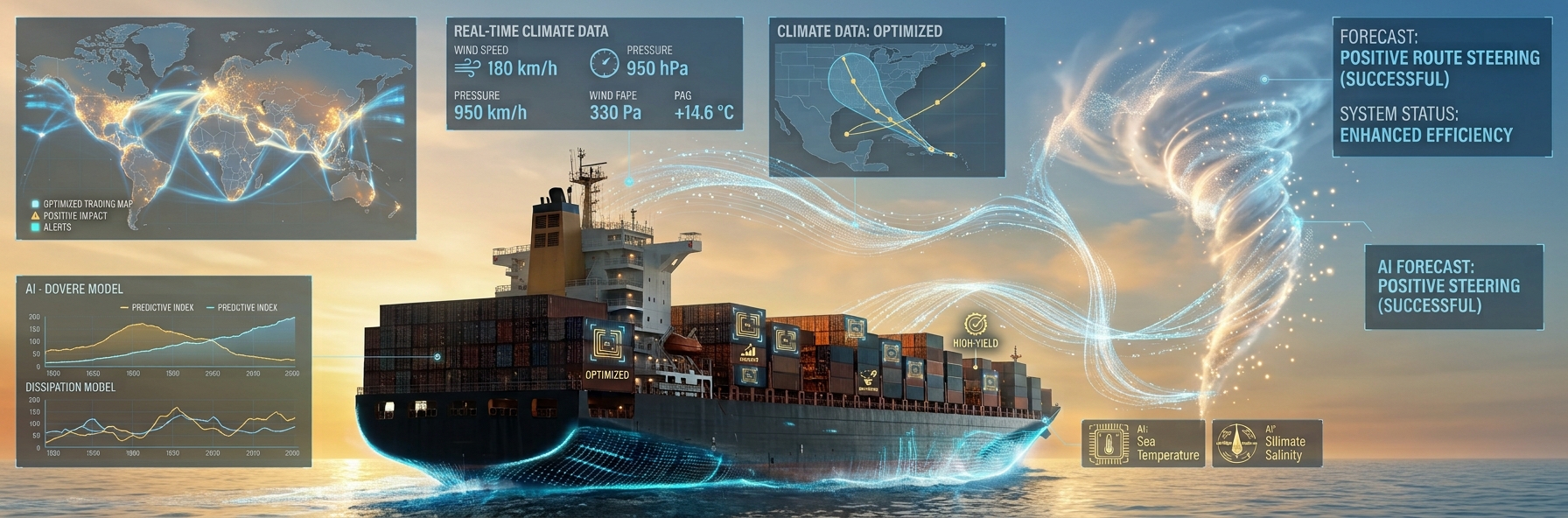
In August 2026, global supply chains are being hit by a "compound weather disruption" - Typhoon Dolphin has crippled China's Ningbo and Shanghai ports, while extreme drought has pushed Europe's Rhine and Danube rivers to critically low levels. Two seemingly unrelated weather events are triggering a chain reaction across global trade networks: vessel bunching, capacity crunches, cargo rollovers, and spiraling costs.
This is no isolated incident. Climate risk is becoming the single greatest source of uncertainty in supply chains. As traditional "reactive" models prove inadequate, MG Ship - a global logistics technology leader, is using predictive AI to offer a new path forward.
A "Perfect Storm" in Global Supply Chains
In eastern China, Typhoon Dolphin forced the temporary closure of Ningbo and Shanghai ports, disrupting container gates, vessel movements, trucking, feeder and barge services. Ningbo had already been experiencing vessel waiting times of around two to three days before the closure. Even as ports reopen, Shanghai is still reporting delays of approximately three to nine days, while Ningbo continues to face schedule-recovery challenges.
Meanwhile, Europe's inland waterways are facing a crisis of their own. Extremely low water levels on the Rhine and Danube are restricting barge cargo capacity, limiting access between major ports such as Rotterdam and Antwerp and industrial centres in Germany and Central Europe.
The combined impact goes far beyond "a few days of delay": vessel bunching creates berth congestion, cargo is rolled, schedules are upended, and transport costs soar. For manufacturers and retailers reliant on just-in-time inventory, components and finished goods from East Asia face potential shortages.
More troubling still, congestion is spreading—as shippers divert cargo to alternative ports, those locations quickly experience yard saturation, equipment shortages, and longer truck queues. Industry analysis suggests East Asian container freight disruptions could persist for another one to two weeks.
From Reactive to Predictive: MG Ship's Intelligence Platform
This is the core value proposition of MG Ship's AI-powered multimodal tracking platform. Built for brands, distributors and producers, the platform unifies fragmented logistics processes into a single, intelligence-driven system. By combining real-time tracking with predictive AI, MG Ship enables businesses to anticipate delays, prevent stockouts, and better align supply with demand.
Three Core Capabilities for Today's Supply Chain Challenges
First, end-to-end visibility. The platform provides coverage across 220+ countries and territories, integrating more than 1,000 carriers and customs partners. Whether cargo is moving by ocean, air, road, rail or parcel, businesses can track it in real time on a single dashboard. Through API integrations, the platform feeds seamlessly into existing transport management systems, ERP platforms and customer-facing systems.
Second, predictive AI analytics. Unlike traditional tracking tools that simply tell you where cargo is, MG Ship tells you what could go wrong. Predictive AI models forecast delays, monitor carrier performance, and identify potential service-level agreement breaches. Logistics teams can spot anomalies and intervene proactively - before customer commitments are broken.
Third, real-time risk intelligence. The platform doesn't just track shipments, it provides comprehensive intelligence covering geopolitical developments, trade lane disruptions, tariff changes and regulatory updates. Through a strategic partnership with Hong Kong's Logistics and Supply Chain MultiTech R&D Centre (LSCM), MG Ship has also integrated medium and long range weather forecasting capabilities for major global shipping routes, enabling carriers and traders to adjust routes and optimise risk management well in advance.
Data-Driven Business Value
The platform's performance metrics are compelling: 99% ETA accuracy and 99% global track-and-trace integration. Retailers can plan inventory and promotions with greater confidence, while manufacturers can synchronize production with logistics flows.
Critically, the platform consolidates shipment and customs data into a secure system that supports in-transit inventory financing, helping suppliers access liquidity faster. For cash-constrained small and medium-sized enterprises, this can be a game-changer.
Conclusion: A New Era of Supply Chain Resilience
Typhoons pass. Droughts ease. But extreme weather events are increasing in frequency and intensity. As one industry observer put it: "Climate is becoming one of the biggest supply chain risks."
For shippers, brands and manufacturers, the optimal strategy is no longer "lowest freight cost", it's balancing cost, resilience and flexibility. Because the most expensive disruption is always the one that stops production or leaves customers without stock.
MG Ship is redefining supply chain management through predictive intelligence. While others scramble to react to typhoons and droughts, MG Ship users are already planning ahead, adjusting proactively, because true supply chain resilience starts with seeing the risks others miss, and acting before they materialise.
MG Ship – Track. Analyse. Turn insight into action.
Source: https://www.dcvelocity.com/transportation/maritime-ocean/extreme-weather-cramps-logistics-flows-in-europe-china