
Walmart's E-commerce Surge: A Blueprint for Value Creation in Retail
Walmart's recent e-commerce surge, driven by a focus on price, speed, and convenience through pickup, delivery, and its online marketplace, offers critical insights for business leaders aiming to optimize financial and operational value. This analysis explores how these strategic pillars translate into tangible benefits across efficiency, cost, productivity, and growth.
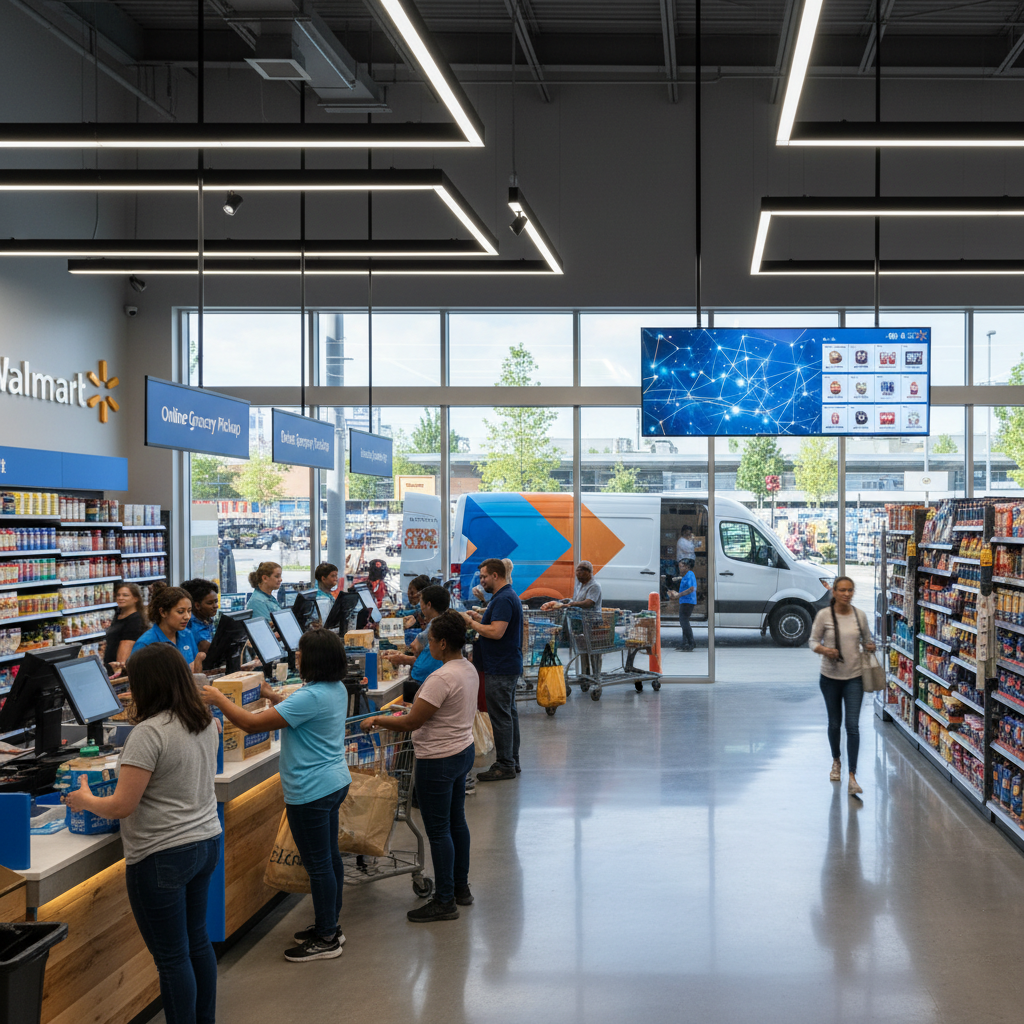
In an increasingly competitive retail landscape, Walmart's significant e-commerce growth, highlighted by its CEO's emphasis on 'price, speed and convenience,' provides a compelling case study in strategic value creation. The expansion of pickup and delivery services, alongside a robust online marketplace across both domestic and international operations, demonstrates a holistic approach to meeting evolving consumer demands while simultaneously bolstering key financial and operational metrics. For business leaders, this success story offers a blueprint for how integrated strategies can drive substantial gains in efficiency, cost management, productivity, and ultimately, sustainable growth.
Operation efficiency
Walmart's e-commerce surge is fundamentally rooted in enhanced operational efficiency. The emphasis on 'speed and convenience' for customers directly translates to streamlined internal processes. The robust growth in pickup and delivery services necessitates highly optimized logistics, inventory management, and last-mile fulfillment. This involves efficient routing for delivery vehicles, precise scheduling for customer pickups, and rapid order processing within fulfillment centers or stores. An effective online marketplace also demands seamless integration with third-party sellers, requiring efficient data exchange, inventory synchronization, and order management systems. Achieving 'speed' at scale, across both U.S. and international markets, means that every step from order placement to customer receipt must be meticulously planned and executed. Technologies that provide real-time visibility into inventory levels, order status, and shipment movements are crucial. For instance, a shipment-visibility control tower (MGS) could play a pivotal role here, offering end-to-end transparency across the supply chain, enabling proactive issue resolution, optimizing delivery routes, and ensuring that products reach customers as quickly and conveniently as promised. This level of operational rigor not only satisfies customers but also reduces waste and improves throughput, forming the bedrock of the e-commerce success.
Cost reduction
Driving e-commerce growth while maintaining competitive 'price' points, as touted by Walmart's CEO, inherently involves significant cost reduction efforts. The expansion of pickup services, for example, can be a strategic lever for lowering last-mile delivery expenses, which are often the most costly component of e-commerce fulfillment. By shifting the final leg of delivery responsibility to the customer, Walmart can reduce its own transportation and labor costs associated with door-to-door delivery. Furthermore, optimizing delivery routes through advanced planning and real-time tracking, potentially aided by tools like an MGS, can minimize fuel consumption and driver hours per delivery. The online marketplace model can also contribute to cost reduction by expanding product assortment without the capital expenditure and inventory holding costs associated with stocking every item directly. This asset-light approach for certain product categories can improve overall cost structures, allowing Walmart to offer competitive pricing while preserving or improving profitability.
Organizational productivity
The ability to achieve a 'surge' in e-commerce sales, particularly through complex channels like pickup and delivery, speaks volumes about Walmart's organizational productivity. This growth indicates that the company's internal structures, systems, and workforce are effectively collaborating to handle increased volume and complexity. Productivity gains are realized through optimized workflows in fulfillment centers, efficient store-level processes for pickup orders, and seamless coordination between various departments involved in the online marketplace. The deployment of technology to automate tasks, improve communication, and provide actionable insights allows employees to focus on higher-value activities. For instance, an MGS can enhance productivity by reducing manual tracking efforts, providing clear visibility into potential delays, and enabling teams to reallocate resources more effectively to keep operations running smoothly and efficiently. This focus on doing more with existing resources, or scaling resources intelligently, is critical for translating sales growth into profitable growth.
Customer profitability maximization
Walmart's strategy of emphasizing 'price, speed and convenience' is a direct approach to maximizing customer profitability. By offering competitive pricing, the company attracts a broad customer base. The 'speed and convenience' provided by pickup and delivery services, along with the expanded selection of an online marketplace, enhances the overall customer experience, fostering loyalty and increasing purchase frequency. Satisfied customers are more likely to make repeat purchases and potentially increase their average order value over time. The marketplace model, by offering a wider array of products, can capture a larger share of a customer's spending across various categories. Furthermore, by making shopping inherently more convenient, Walmart reduces friction points that might otherwise lead customers to competitors, thereby extending customer lifetime value. This focus on a superior value proposition ensures that the growing customer base is also a profitable one.
Cash flow optimization
The 'e-commerce sales surge' inherently contributes to improved cash flow. The nature of online transactions, particularly for pickup and delivery services, often involves upfront payment from customers, which accelerates cash conversion cycles compared to traditional retail models that might involve delayed payment or credit terms. The rapid turnover of inventory, driven by increased sales volume, also means that capital is tied up in inventory for shorter periods. Furthermore, the online marketplace model can be cash-flow positive for Walmart, as it typically operates on a commission basis, receiving payments from third-party sellers after their sales. This reduces the need for Walmart to invest its own capital in a vast inventory for marketplace items. Efficient operations, supported by tools like an MGS that minimize delays and optimize delivery, further contribute to cash flow by reducing carrying costs and preventing stockouts that could lead to lost sales and delayed revenue.
Workforce optimization
Achieving 'speed and convenience' for a surging e-commerce business, especially across 'U.S. and international businesses,' demands a highly optimized workforce. This includes efficient staffing models for fulfillment centers, effective training for associates handling in-store pickups, and optimized routing and scheduling for delivery drivers. Technology plays a crucial role in empowering this workforce, from handheld devices for order picking to sophisticated algorithms for delivery route optimization. By providing clear, data-driven instructions and minimizing unproductive time, Walmart can ensure its employees are working at peak efficiency. For example, real-time insights from an MGS can help dispatchers and warehouse managers dynamically adjust staffing levels or reassign tasks based on demand fluctuations or unforeseen operational challenges, ensuring that labor resources are always aligned with operational needs and customer expectations for speed and convenience.
Sales effectiveness
The 'e-commerce sales surge' is a direct testament to Walmart's sales effectiveness. The strategic emphasis on 'price, speed and convenience' serves as a powerful sales proposition that resonates with modern consumers. By expanding channels like 'pickup, delivery and its online marketplace,' Walmart has effectively removed barriers to purchase and made its offerings more accessible and appealing. The ability to grow sales across both its 'U.S. and international businesses' demonstrates a globally effective sales strategy. This isn't just about attracting new customers, but also about increasing the engagement and spending of existing ones through a diversified and convenient shopping experience. The integration of various e-commerce touchpoints ensures that customers can interact with Walmart in the way that best suits their needs, thereby maximizing conversion rates and overall sales volume.
Revenue optimization
Walmart's e-commerce surge signifies successful revenue optimization strategies. By focusing on 'price, speed and convenience,' the company has created a compelling value proposition that drives higher transaction volumes and potentially larger average basket sizes. The expansion into 'pickup, delivery and its online marketplace' represents a multi-pronged approach to capturing a wider range of customer needs and preferences, thereby expanding the total addressable market. The online marketplace, in particular, allows Walmart to generate revenue from a broader assortment of products without the direct inventory risk. Furthermore, by operating across 'U.S. and international businesses,' Walmart diversifies its revenue streams and capitalizes on growth opportunities in different geographical markets. This comprehensive strategy ensures that the company is not just growing sales, but optimizing the overall revenue generation capacity of its e-commerce ecosystem.
High-growth opportunities
The 'e-commerce sales surge' itself is the clearest indicator of high-growth opportunities for Walmart. The continued strong performance in 'pickup, delivery and its online marketplace' points to these channels as significant avenues for future expansion. The fact that this growth is occurring across both 'U.S. and international businesses' underscores the global potential of these e-commerce initiatives. For business leaders, this highlights the importance of investing in digital infrastructure, logistics capabilities, and platform development to capitalize on evolving consumer behaviors. The ability to scale these services efficiently and effectively will be paramount to sustaining this high-growth trajectory and capturing an even larger share of the global retail market. The strategic focus on 'speed and convenience' ensures that Walmart is positioned to meet future customer expectations and continue its upward growth trajectory in the digital commerce space.
Source: Fox Business — https://www.foxbusiness.com/retail/walmart-e-commerce-sales-surge-ceo-touts-price-speed-convenience