
Suez Canal Reopening: A Glimmer of Hope for East-West Maritime Trade
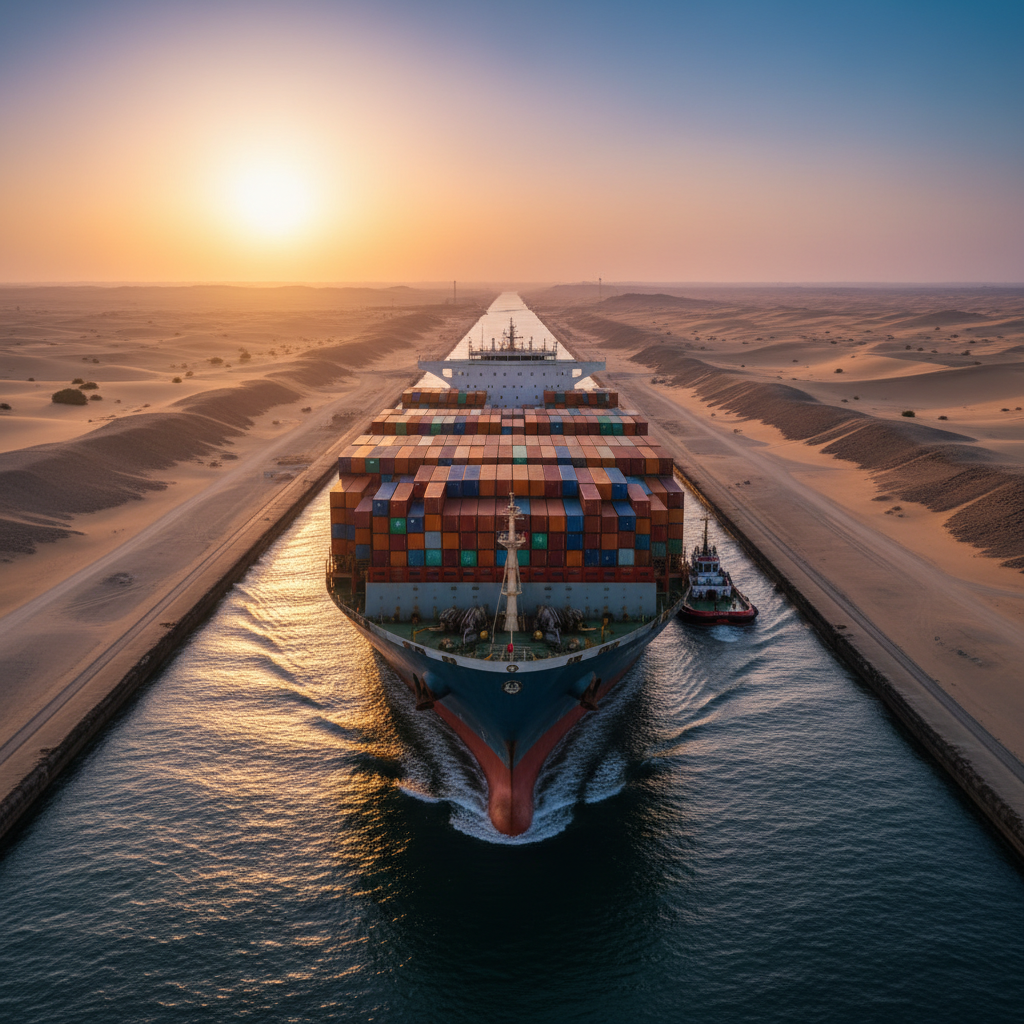
Container ships are cautiously resuming transit through the Suez Canal, signaling a potential shift in global maritime logistics. This development, impacting routes from India to the U.S. East Coast, offers a chance to alleviate the extended transit times and increased costs that have plagued supply chains since late 2023.
How this impacts the global supply chain
The recent cautious return of some container ships to the Suez Canal route, particularly for maritime cargo moving from India to the U.S. East Coast, marks a significant potential shift in global supply chain dynamics. For months, since late 2023, vessels were forced to undertake an arduous detour around the southern end of Africa to circumvent missile threats in the Red Sea. This extended routing had profound implications for global supply chain flows, capacity, and operational efficiency.
Firstly, regarding flows and routes, the re-evaluation of the Suez Canal's viability offers a direct and substantially shorter passage for a critical trade lane. The previous detour around Africa added thousands of nautical miles and weeks to transit times, creating a bottleneck that rippled across global networks. A sustained return to the Suez Canal would restore a more direct and historically efficient artery for East-West trade, especially for goods originating in India and destined for the U.S. East Coast. While the current activity is described as "testing," it suggests a potential de-escalation of perceived risks or a strategic re-assessment by shipping lines of the balance between risk and efficiency.
Secondly, the impact on capacity is substantial. When ships are forced onto longer routes, they spend more time at sea for each voyage. This effectively ties up vessels for longer periods, reducing the overall available capacity in the global fleet without any physical reduction in the number of ships. A return to the Suez Canal means vessels complete their journeys faster, freeing them up for subsequent sailings sooner. This 'effective' increase in capacity can help alleviate pressure on vessel availability and potentially lead to more frequent service offerings on key routes, improving overall network fluidity.
Finally, operations stand to benefit significantly. Shorter transit times translate directly into more predictable schedules and reduced lead times for goods. For supply chain managers, this means less uncertainty in planning and inventory management. Reduced time at sea also typically means lower fuel consumption per voyage, contributing to operational cost savings and potentially a more environmentally friendly profile for these routes. The operational complexity introduced by the African detour, including altered bunkering schedules and crew rotations, would also be eased, allowing for a more streamlined and efficient maritime logistics operation.
Global financial impact
The financial implications of container ships beginning to test the Suez Canal route are significant and largely positive for all stakeholders in global trade. The prolonged detour around Africa, necessitated by security concerns, introduced a raft of additional costs that have impacted shippers, carriers, and the broader economy.
For shippers, the primary financial benefits stem from reduced transit times and potentially lower freight costs. Extended voyages mean higher inventory carrying costs, as goods spend more time in transit rather than in warehouses or on store shelves. This ties up capital and increases the risk of obsolescence for time-sensitive products. A return to the Suez Canal shortens these cycles, reducing inventory holding costs and improving cash flow. Furthermore, the source mentions that "maritime insurance providers to hike their rates" due to the Red Sea threats. A sustained return to the Suez, implying a reduction in perceived risk, could lead to a stabilization or even reduction in these insurance premiums, which are often passed on to shippers as surcharges. Lower fuel consumption for shorter routes would also contribute to reduced bunker adjustment factors (BAFs), further lowering overall freight expenses.
Carriers stand to gain substantially from the operational efficiencies. The most immediate financial saving comes from significantly reduced fuel consumption due to the shorter distance. Fuel is one of the largest operating expenses for shipping lines, so cutting thousands of miles off a journey directly impacts their bottom line. Beyond fuel, a reduction in perceived risk could lead to lower insurance premiums for their vessels operating in the region. Improved vessel utilization, as ships complete voyages faster, means carriers can deploy their existing fleet more efficiently, potentially increasing the number of revenue-generating trips per vessel per year. This enhanced efficiency can translate into stronger financial performance for shipping lines, potentially allowing them to offer more competitive rates.
For trade at large, the financial impact is one of increased efficiency and reduced inflationary pressure. The added costs of the African detour – higher freight rates, insurance surcharges, and inventory costs – ultimately contribute to higher prices for consumers. A more efficient and cost-effective Suez route can help mitigate these inflationary pressures on goods imported via this corridor. It fosters greater predictability in supply chains, which is crucial for business planning and investment, thereby boosting overall confidence in global trade. The re-establishment of a key trade artery also supports the competitiveness of goods moving between India and the U.S. East Coast, benefiting economies on both ends.
How MGS can help navigate today's global trade environment
In an environment characterized by such dynamic and unpredictable shifts, a shipment-visibility control tower like MGS becomes an indispensable tool for operators. The decision by shipping lines to "test" the Suez Canal route underscores the ongoing uncertainty and the need for real-time, actionable intelligence.
Real-time visibility is paramount. MGS provides granular, real-time tracking of every container and vessel, allowing shippers and logistics providers to immediately identify which route their cargo is taking – whether it's the traditional Suez path or still the longer detour around Africa. This is not just about knowing where a ship is, but understanding the context of its journey. As some lines test the Suez while others may still opt for the longer route, MGS can differentiate between these strategies across a shipper's entire portfolio, preventing assumptions and enabling precise planning.
Furthermore, MGS significantly enhances risk management. If the Suez route's viability remains precarious, or if security incidents cause a sudden reversal, MGS can provide immediate alerts on vessels entering or exiting designated risk zones. This allows supply chain managers to proactively engage with carriers, re-evaluate contingency plans, or communicate potential delays to downstream stakeholders, rather than reacting to news days or weeks later. The ability to visualize potential disruptions on a global map and drill down to specific shipments is critical for mitigating the financial and reputational damage of unforeseen events.
For decision support, MGS empowers operators to make informed choices in a volatile landscape. For shippers, understanding the actual transit times and reliability of carriers utilizing the Suez route versus the African detour can influence future booking decisions and carrier selection. For carriers, MGS data can help optimize fleet deployment, ensuring vessels are routed efficiently and schedules are adhered to, especially as they adapt to changing geopolitical realities. The platform's ability to aggregate and analyze data across multiple carriers and routes provides a comprehensive overview that individual tracking portals cannot match, enabling strategic adjustments to inventory levels and distribution networks based on the most current and accurate information available.
Demand–supply analysis & improvement
The situation surrounding the Suez Canal and the Red Sea has created a fascinating dynamic in maritime demand and supply. Fundamentally, the demand for shipping goods from India to the U.S. East Coast has remained relatively constant, driven by consumer and industrial needs. However, the effective supply of shipping capacity for this route was severely constrained by the forced detour.
When vessels were rerouted around Africa, the same number of ships were available, but each ship took significantly longer to complete a round trip. This effectively reduced the total available slots and capacity on the route, leading to a tightening of supply relative to demand. This imbalance typically results in higher freight rates and reduced service reliability. The current development, where some shipping lines are testing a return to the Suez Canal, represents a direct improvement in effective supply. By shortening transit times, these vessels are able to complete more voyages within a given period, thereby increasing the available capacity without requiring the introduction of new ships. This re-balancing of the supply-demand equation can lead to more stable and potentially lower freight rates, as well as improved schedule integrity.
Concrete improvement levers for both carriers and shippers emerge from this shift. Carriers can leverage the shorter route to optimize their vessel rotations, potentially offering more frequent sailings or reallocating freed-up capacity to other high-demand routes. This allows for better utilization of their assets. For shippers, the improved supply dynamics mean greater choice, potentially better service contracts, and reduced lead times, enabling them to refine their inventory strategies and reduce safety stock levels. The increased reliability also allows for more just-in-time (JIT) approaches, reducing warehousing costs and improving responsiveness to market changes. The ability to return to a more efficient route directly addresses the supply constraint imposed by the geopolitical situation, offering a tangible pathway to improved operational and financial performance across the supply chain.
ROI-focused resilience
The recent shifts in Suez Canal usage underscore the critical importance of resilience in supply chains, framed in terms of Return on Investment (ROI). The initial move to detour around Africa was a resilience action, albeit a costly one, taken to protect against the quantified risk of "missile threats" and the resulting "maritime insurance providers to hike their rates." While the source does not provide specific figures for these increased costs, the very necessity of the extended route and the explicit mention of hiked insurance rates clearly indicate significant financial exposure.
Investing in resilience, in this context, means implementing strategies and tools that minimize the financial impact of such disruptions. The investment in a robust supply chain strategy, which includes route optionality and real-time visibility, directly protects against the risk of prolonged, costly detours and escalating operational expenses. For instance, the cost of the extended route around Africa includes substantially higher fuel consumption, increased crew costs for longer voyages, and the opportunity cost of reduced vessel utilization. The "hike" in maritime insurance rates represents another direct, quantifiable financial burden.
An MGS shipment-visibility control tower, for example, represents an investment that yields significant ROI in resilience. Its ability to provide immediate insights into changing route dynamics, such as the current Suez testing, allows shippers to quickly adapt. The ROI is realized by avoiding the full extent of costs associated with prolonged disruptions. This includes: avoiding unnecessary insurance surcharges by quickly identifying carriers returning to safer, shorter routes; avoiding excessive inventory holding costs by better predicting transit times; and avoiding potential penalties or lost sales due to delayed deliveries. The cost of not having such visibility and agility during the initial Red Sea crisis was the absorption of higher freight rates, extended lead times, and increased working capital tied up in transit. The ROI of resilience, therefore, is the direct savings achieved by mitigating these known, albeit unquantified in the source, financial risks, positioning a company to navigate geopolitical volatility with greater financial stability and operational continuity.
Source: DC Velocity — https://www.dcvelocity.com/transportation/maritime-ocean/container-ships-begin-testing-suez-canal-route-georgia-ports-says