
From Tracking to Predictive ETA: Integration as a Resilience Strategy
In 2026 visibility integration moves beyond tracking to predictive ETAs that write back into ERP and TMS, turning data pipelines into board-level resilience.
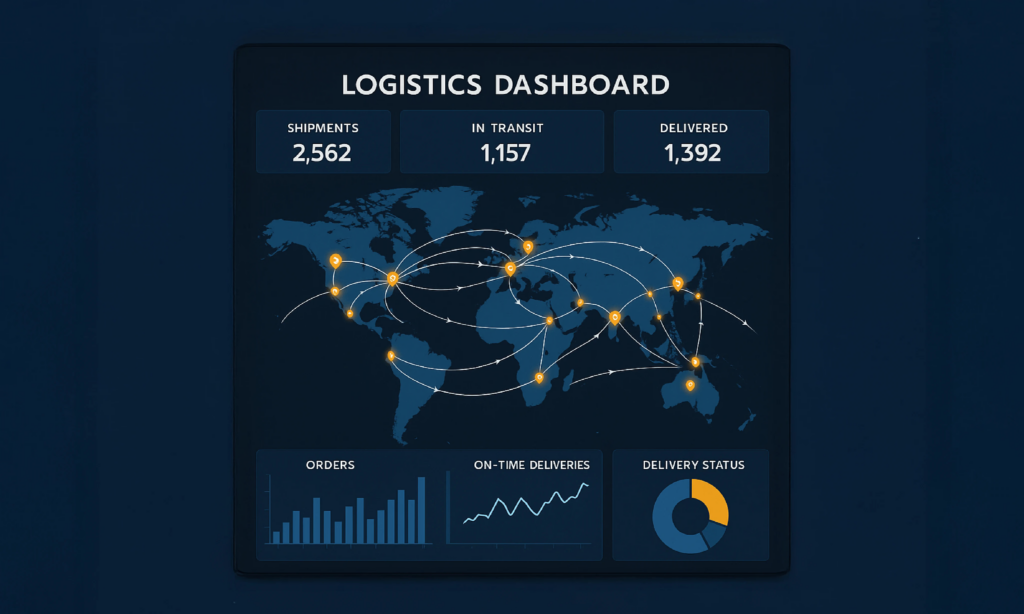
Supply chains in 2026 are governed less by static schedules and more by probabilistic forecasts. The shift from milestone-based tracking — where a shipper learns of a delay only after a container has already missed a connection — to predictive estimated time of arrival (ETA) represents a structural change in how logistics risk is managed. That shift is now flowing from the warehouse floor to the boardroom agenda.
From Reactive Tracking to Predictive Foresight
For most of the previous decade, visibility meant a breadcrumb trail of scan events pushed by carrier systems at irregular intervals. A container left the origin port, appeared again at a transshipment hub, and resurfaced at the discharge port — with little signal in between. When delays occurred, operations teams discovered them after the fact.
Predictive ETA changes the architecture fundamentally. Rather than reporting what has happened, the system models what is likely to happen next. It ingests vessel AIS feeds, port congestion indices, historical dwell-time distributions, and weather overlays, then applies statistical models to produce a continuously updated arrival probability. A shipment that was showing an on-time status may quietly shift to a 73% probability of delay three days before the vessel even reaches the transshipment port — early enough for operations to act rather than react.
The Integration Layer Is the Strategy
Predictive ETA is only as valuable as the downstream systems that consume it. An ETA computed in isolation — visible only inside a freight visibility dashboard — delivers operational convenience. An ETA that writes back into an ERP system triggers automatic purchase order rescheduling. One that feeds a TMS updates delivery commitments across connected carriers. One that populates a customer-facing portal closes the loop with end clients before they need to call.
This write-back capability is why integration architecture has become a board-level conversation rather than a purely technical one. Supply chain disruptions now register on earnings calls, in investor presentations, and in regulatory filings. Executives who once asked "where is the shipment?" now ask "how much notice did we have, and how did our systems respond?" The answer lies in whether the visibility layer is connected to the systems of action — or siloed in a standalone portal.
The integration stack required for true predictive resilience typically involves several components:
- Real-time carrier API connectivity with normalized event schemas
- Machine learning models trained on lane-specific historical performance
- Bidirectional ERP connectors (SAP, Oracle, NetSuite) for purchase order propagation
- TMS hooks that allow automatic carrier substitution workflows
- Customer notification pipelines triggered by confidence-threshold breaches
Normalization: The Unglamorous Prerequisite
Before any of the above can function, raw carrier data must be normalized. Each carrier publishes milestones using its own event codes, timestamps, and status vocabularies. One carrier's "GATE IN" is another's "Container Received at Terminal." One publishes UTC timestamps; another publishes local terminal time without offset notation. Without a normalization layer that maps these heterogeneous signals into a common event schema, predictive models receive noise rather than signal.
This normalization problem is less exciting to present in a board deck than a predictive ETA dashboard. Yet it consistently emerges as the primary failure point in enterprise visibility implementations. Organizations that invest heavily in AI-powered ETA models but underinvest in the data quality layer beneath them find their predictions drifting from reality as the carrier data deteriorates.
Multi-Carrier Coverage as a Resilience Signal
Single-carrier visibility is table stakes for a logistics department. For supply chain resilience at enterprise scale, coverage breadth matters. When a primary carrier suffers a port congestion event, a Red Sea bypass, or an equipment shortage, decision-makers need to evaluate alternative routings immediately — and that evaluation requires performance data from alternative carriers already flowing into the same normalized pipeline.
Multi-carrier benchmarking, where ETA accuracy and exception rates are tracked across carriers on comparable lanes, transforms the visibility platform into a procurement tool. A carrier that consistently delivers 94% of shipments within 24 hours of predicted arrival commands a different rate negotiation position than one operating at 78%.
Why This Reaches the Boardroom
Three factors have elevated supply chain visibility from a logistics metric to a financial governance topic. First, inventory carrying costs have become more visible as interest rates moved higher, making demand planning accuracy more directly quantifiable on the balance sheet. Second, customer delivery commitments — particularly in B2B manufacturing and retail supply chains — now carry contractual penalties for failure, creating a financial line item directly tied to ETA accuracy. Third, ESG reporting requirements increasingly demand data on transport emissions, which can only be measured at the shipment level if milestone data is granular enough to reconstruct actual routes.
The control tower concept — a unified view of all in-transit shipments, active exceptions, and carrier performance signals — has evolved from an operations center tool into an executive reporting layer. When exception rates are categorized by root cause (carrier delay, port congestion, documentation hold), the visibility data supports operational post-mortems that directly inform contract negotiations and carrier scorecard reviews. Multi-carrier visibility platforms like MGS provide the normalized event pipeline, predictive ETA engine, and exception management workflows that make this level of operational intelligence accessible without requiring a bespoke data engineering effort for each carrier integration.
Predictive ETA is not a feature. It is the output of a correctly instrumented integration architecture — one where data quality, normalization, and system connectivity have been treated as foundational rather than iterative improvements.
Source: PostalParcel