
North American Trade Tensions: Navigating the Logistics Fallout from US-Canada Tariff Escalation
The recent imposition of 50% tariffs on $20 billion of Canadian goods by the US, and Canada's swift response, has transformed a trade dispute into a critical North American logistics challenge. This brief explores the far-reaching impacts on global supply chains, financial implications for businesses, and how advanced visibility platforms like MGS are essential for navigating this complex environment.
How this impacts the global supply chain
The U.S.-Canada tariff escalation, with 50% tariffs on approximately $20 billion of Canadian goods and Canada's swift response, has transformed a trade dispute into a critical North American logistics challenge. This fundamentally alters logistics flows, routes, capacity, and operations, with global ripple effects.
Established cross-border flows now face significant friction. Companies optimized for seamless U.S.-Canada movement must re-evaluate sourcing and distribution. This will likely lead to trade diversion, as businesses seek alternative suppliers or markets, potentially shifting demand to other international partners or encouraging domestic production.
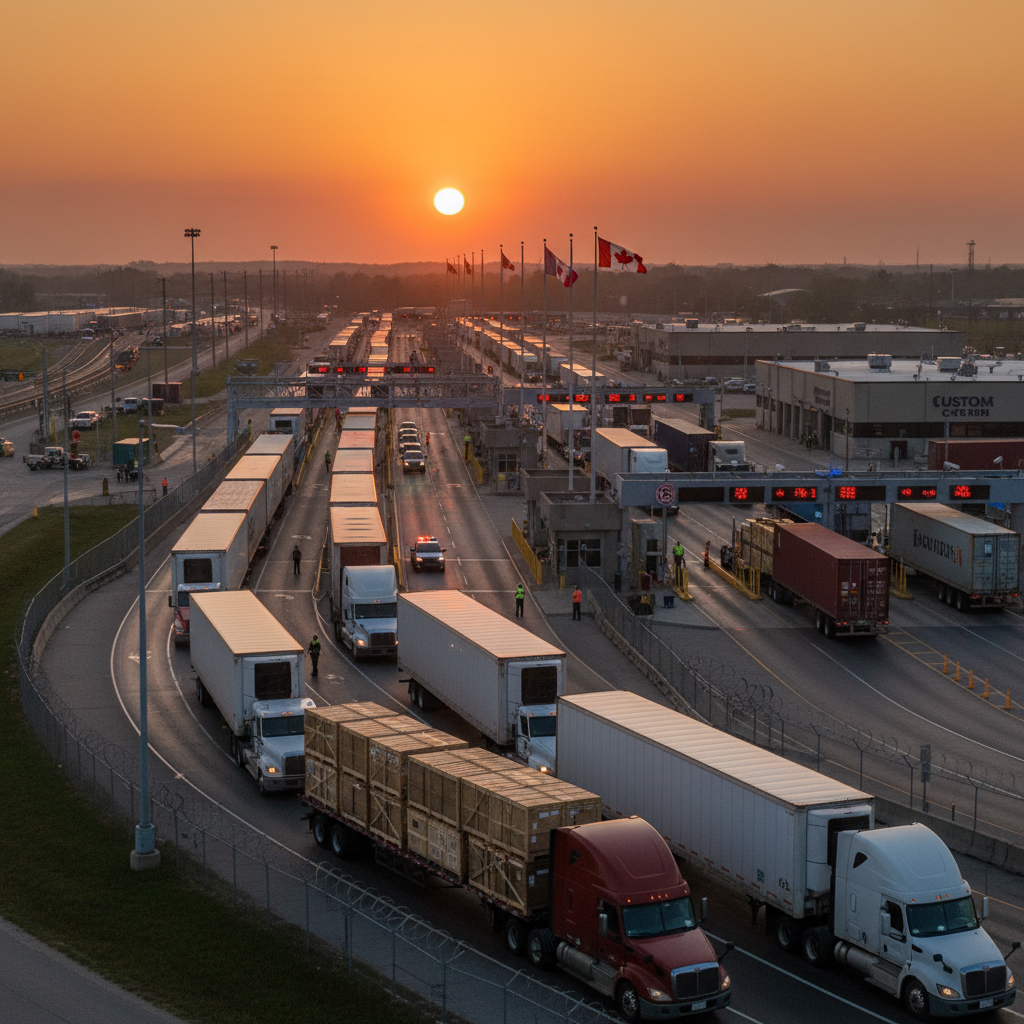
Existing logistics routes will undergo transformation. Primary land corridors will experience heightened scrutiny and delays at customs, leading to longer, less predictable transit times. Shippers may explore less conventional routes or modes, like maritime or air freight, to bypass land border complexities, potentially straining capacity and introducing new bottlenecks.
Overall North American logistics capacity will be challenged. Increased demand on alternative routes and border crossings will create congestion. The administrative burden of new tariffs—documentation, compliance checks—will slow processing, reducing throughput capacity. Carriers, especially cross-border trucking, will face increased operational costs and delays, impacting schedules and asset utilization.
Day-to-day operations for countless businesses become more complex. Supply chain managers must navigate heightened uncertainty, increased regulatory compliance, and volatile shipping costs. This demands an agile, responsive approach to logistics planning, requiring real-time visibility and quick pivots in response to evolving trade conditions.
Global financial impact
The U.S.-Canada tariff escalation carries profound financial ramifications, creating significant cost pressures and economic uncertainty. The 50% tariff on approximately $20 billion of Canadian goods, and Canada's retaliation, directly translates into billions of dollars in added costs.
For shippers, the immediate impact is a substantial increase in landed costs. The 50% tariff on $20 billion means an additional $10 billion in direct duties, absorbed, passed on, or shared. This forces companies to re-evaluate pricing, potentially eroding profit margins or reducing competitiveness. Beyond tariffs, shippers face elevated freight costs due to longer transit times, increased fuel consumption, and potential carrier surcharges. Inventory holding costs will rise as goods spend more time in transit. Administrative burdens add further expense, potentially reducing trade volumes.
Carriers face a mixed financial landscape. Operational environments become more challenging with increased border delays and customs inspections, reducing asset utilization and driver productivity. This leads to higher per-mile operating costs and impacts profitability. Unpredictability makes scheduling difficult.
At large, U.S.-Canada trade faces significant headwinds. Tariffs disincentivize cross-border commerce, potentially leading to bilateral trade contraction. This can fuel inflation and dampen economic growth in reliant sectors. Integrated supply chains in automotive, agriculture, and manufacturing are particularly vulnerable. Companies may consider nearshoring or reshoring, entailing significant upfront investment and disruption.
How MGS can help navigate today's global trade environment
In an environment of escalating tariffs, disrupted logistics, and heightened uncertainty, a sophisticated shipment-visibility control tower like MGS is indispensable. MGS offers critical intelligence and control to navigate the complexities introduced by the U.S.-Canada tariff escalation.
Firstly, MGS provides unparalleled real-time visibility into every shipment, from origin to destination. With border delays, customs inspections, and re-routing common, knowing the precise location and status of goods is paramount. MGS tracks shipments across modes and borders, identifying delay points. This granular visibility is crucial for proactive management, enabling supply chain teams to anticipate issues at congested crossings or new inspection points.
Secondly, MGS empowers proactive decision-making and rapid response. When a 50% tariff is applied or a route becomes unfeasible, businesses need to pivot quickly. MGS flags potential delays or cost increases on specific lanes, allowing logistics managers to explore alternative routes or modes in real-time. For instance, if a land border is backlogged, MGS highlights this, enabling diversion or a temporary shift to air freight for critical components, weighing costs against urgency within the platform.
Thirdly, MGS assists in managing heightened compliance and documentation. While not directly handling customs, its ability to centralize shipment data provides a single source of truth, streamlining compliance. Consistent data on status, origin, destination, and ETA helps ensure accurate, timely documentation, reducing risks of delays or penalties.
Finally, MGS contributes significantly to cost optimization and performance monitoring. Insights into transit times, carrier performance, and route changes help identify cost-effective, reliable logistics strategies. If tariffs make a product line unprofitable, MGS helps analyze alternative sourcing or transportation. It also allows objective carrier evaluation, ensuring service levels and identifying negotiation areas. MGS transforms raw logistics data into actionable intelligence, enabling companies to navigate tariff-induced complexities with greater control, efficiency, and financial prudence.
Demand–supply analysis & improvement
The U.S.-Canada tariff escalation distorts North American demand and supply dynamics, forcing companies to re-evaluate operations.
On the demand side, 50% tariffs on $20 billion of Canadian goods sharply increase landed costs, influencing consumer demand. Higher prices may reduce consumption or shift to domestic alternatives. Companies must monitor these demand changes, as traditional forecasting will be inaccurate.
From a supply perspective, tariffs create significant friction. Affected suppliers face reduced competitiveness, potentially decreasing cross-border orders. For companies relying on cross-border supply chains for materials, tariffs introduce cost and lead time uncertainty, impacting production and inventory.
To navigate these dynamics, several improvement levers are critical. Supply chain diversification is paramount, exploring alternative sourcing. Network optimization becomes crucial, re-evaluating manufacturing and distribution to minimize tariff-affected cross-border movements, possibly through nearshoring. Enhanced demand forecasting and inventory management using advanced analytics can prevent stockouts and excessive carrying costs. Finally, logistics flexibility—having contingency plans for alternative routes—ensures supply continuity.
ROI-focused resilience
The U.S.-Canada tariff escalation, with 50% tariffs on approximately $20 billion of Canadian goods, presents a clear, quantifiable risk. Framing resilience actions in ROI terms is critical for justifying strategic shifts and investments. The "operating issue" is a direct threat to profitability.
The quantifiable risk is substantial: $10 billion in direct duties, plus cascading effects like increased freight, longer lead times, higher inventory costs, and lost sales. A single significant disruption can halt production and damage customer relationships, leading to substantial revenue loss.
Investing in resilience offers a clear ROI.
- Supply Chain Visibility (e.g., MGS): Offset costs by preventing losses from delays and enabling proactive decisions. Avoiding 1% of $10 billion in potential tariff-related costs is $100 million saved. It also reduces demurrage, optimizes inventory, and improves on-time delivery, protecting revenue.
- Supply Chain Diversification: Establishing alternative suppliers hedges against tariff impacts. Shifting sourcing from a tariff-affected region directly avoids tariff burden, enhancing supply security.
- Nearshoring/Reshoring: Moving production closer to market eliminates tariff exposure. The ROI is complete tariff avoidance, reduced long-term transportation costs, and shorter lead times.
Tariffs transform theoretical supply chain risks into measurable financial penalties. Investments in resilience, particularly those enabled by technology like MGS, are strategic necessities with clear financial justifications, protecting bottom lines and ensuring business continuity.
Source: Logistics Viewpoints — https://logisticsviewpoints.com/2026/08/25/u-s-canada-tariff-escalation-becomes-a-north-american-logistics-problem/