
Navigating the 'New Normal': How Weather-Driven Low Water Levels Disrupt European Supply Chains
Persistent low water levels on critical waterways like the Rhine are no longer anomalies but a 'new normal,' forcing supply chains to adapt. This brief explores the impact on key lanes, facilities, and modes, and how real-time visibility empowers shippers to build resilience.
Introduction
Global supply chains are increasingly vulnerable to the unpredictable forces of nature. While extreme weather events like hurricanes or blizzards often grab headlines, a more insidious and persistent threat is emerging: sustained low water levels on vital inland waterways. What was once considered an infrequent disruption is rapidly becoming a 'new normal,' compelling businesses to fundamentally rethink their logistics strategies. This analysis delves into the profound impact of these environmental shifts, particularly focusing on the crucial Rhine River in Europe, and outlines how shippers can leverage advanced visibility platforms to mitigate risks and maintain operational continuity.
The Rhine, a lifeline for European industry, exemplifies this challenge. Its fluctuating water levels, influenced by changing precipitation patterns and glacial melt, directly dictate the navigability for commercial vessels. When water levels drop significantly, the economic ripple effects are immediate and far-reaching, transforming established shipping paradigms and demanding innovative solutions for cargo movement.
Affected Lanes
The primary lane impacted by low water levels is, unequivocally, the Rhine River itself. This waterway serves as a critical artery, connecting the industrial heartlands of Germany, Switzerland, France, and the Netherlands to major North Sea ports like Rotterdam and Antwerp. It facilitates the movement of vast quantities of raw materials, such as coal, iron ore, and agricultural products, as well as finished goods, chemicals, and petroleum products.
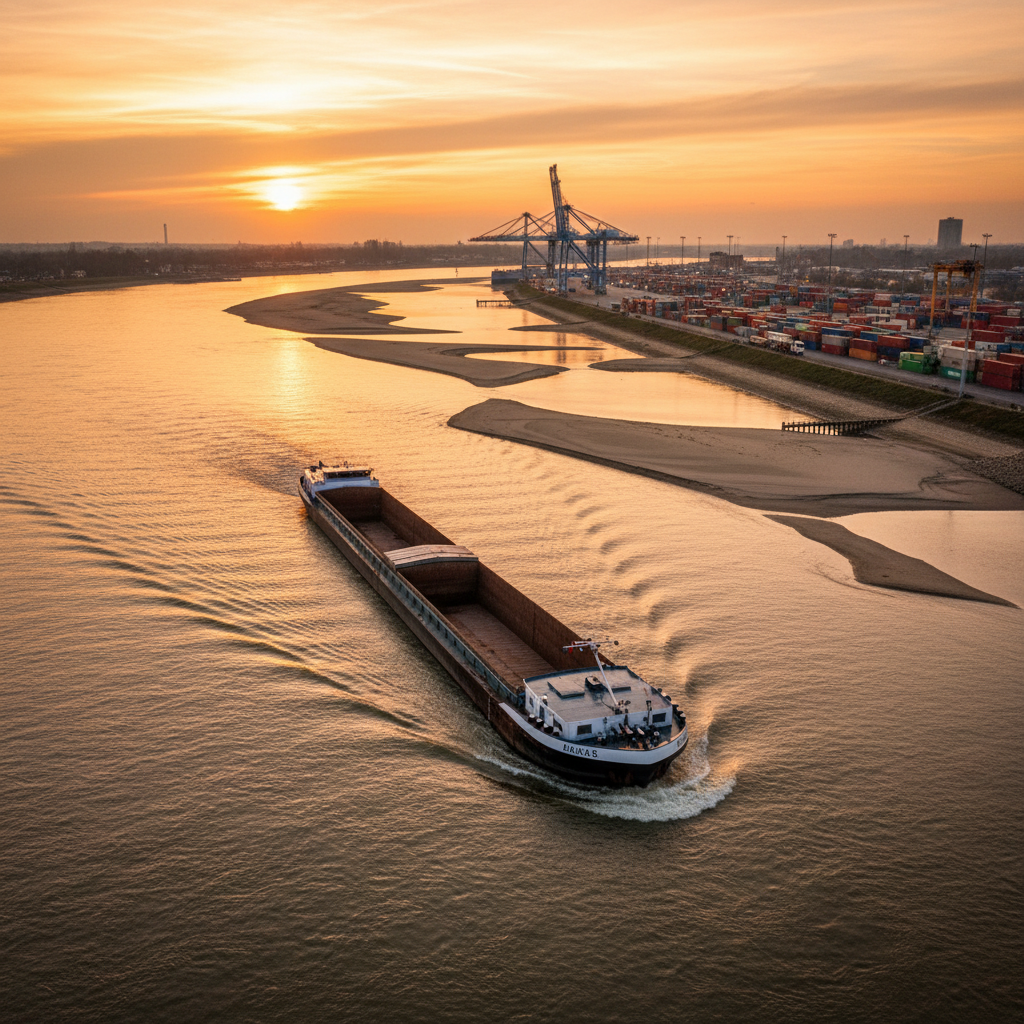
When water levels fall below critical thresholds, barges are forced to reduce their draft, meaning they can carry significantly less cargo to avoid grounding. A vessel designed to carry thousands of tons might only be able to transport a fraction of its capacity, sometimes as little as 25-30%. This reduction in effective capacity leads to a dramatic increase in the number of vessels required to move the same volume of goods, creating bottlenecks and driving up demand for available barge space. The entire flow of goods along this vital corridor slows down, impacting schedules and increasing transit times across the continent.
Affected Facilities
Inland ports and terminals situated along the Rhine are directly and severely affected by these conditions. Major hubs such as Duisburg, a prominent inland port in Germany and a significant logistical nexus, experience considerable operational challenges. When barges arrive with reduced loads or face delays, the efficiency of port operations is compromised. Terminals designed to handle specific cargo volumes and vessel types must adapt to altered loading and unloading procedures. This can lead to increased dwell times for vessels, congestion at berths, and a strain on available storage and transshipment facilities.
Furthermore, the necessity for alternative transport modes (e.g., road or rail) puts additional pressure on intermodal transfer points within these facilities. Warehouses and distribution centers connected to these ports face disruptions to their inbound and outbound schedules, potentially leading to stockouts or overstock situations if not managed proactively. The entire ecosystem of logistics services surrounding these key facilities must grapple with unprecedented volatility.
Affected Modes
The most directly impacted mode is inland waterway transport, specifically the barge and river vessel fleet operating on the Rhine. As their carrying capacity diminishes, the economic viability of river transport for certain goods becomes questionable, and its reliability suffers.
This disruption inevitably triggers a modal shift, pushing cargo onto alternative transport networks. Road freight becomes the immediate, albeit often more expensive and less environmentally friendly, alternative. This surge in demand for trucking services leads to increased road congestion, higher fuel consumption, and a shortage of available drivers and vehicles, particularly during peak disruption periods. Similarly, rail freight experiences increased pressure, but rail infrastructure often has limited flexibility and capacity to absorb sudden, large-scale shifts from waterways, leading to its own set of bottlenecks and delays.
The cascading effect is a significant increase in overall logistics costs, longer lead times, and a heightened carbon footprint for supply chains that traditionally relied on the efficiency and environmental benefits of river transport.
Impact on Shippers
For shippers, the implications of persistent low water levels are multifaceted and severe. Firstly, freight rates for river transport skyrocket due to reduced capacity and increased demand for the available space. When cargo is diverted to road or rail, these alternative modes also see their prices rise, sometimes dramatically, reflecting the sudden surge in demand and operational challenges. This directly impacts a shipper's landed cost of goods and can erode profit margins.
Secondly, lead times become unpredictable and often extended. The need for transshipment, rerouting, or waiting for higher water levels introduces significant delays into the supply chain. This unpredictability makes production planning, inventory management, and customer commitments exceedingly difficult. Businesses face the risk of production line stoppages due to delayed raw material deliveries or missed delivery windows for finished products.
Lastly, the overall resilience of the supply chain is tested. Shippers accustomed to stable, predictable river transport must now contend with a volatile environment, requiring more agile planning, increased buffer stocks, or the development of entirely new logistics networks. The 'new normal' demands a proactive, rather than reactive, approach to logistics management.
MGS Control Tower Solutions
In this challenging environment, a robust shipment-visibility control tower platform like MGS becomes an indispensable tool for shippers. MGS provides real-time, end-to-end visibility across all modes and lanes, including intricate inland waterway movements. By integrating data on water levels, vessel positions, predicted transit times, and alternative transport availability, MGS empowers shippers with actionable intelligence.
Specifically, an MGS control tower can:
- Monitor Water Levels and Vessel Draft: Provide immediate alerts when water levels on critical segments, such as the Rhine, fall below thresholds impacting vessel capacity. This allows for proactive adjustments rather than reactive crisis management.
- Predictive Analytics for Disruptions: Leverage historical data and current conditions to forecast potential delays or capacity constraints, enabling shippers to anticipate issues before they fully materialize.
- Dynamic Re-routing and Modal Shift Planning: Offer scenarios for rerouting cargo via road or rail, complete with estimated costs and transit times, facilitating rapid decision-making when river transport becomes unfeasible or uneconomical. This includes identifying available alternative carrier capacity.
- Enhanced Communication and Collaboration: Centralize communication with carriers, logistics providers, and internal stakeholders, ensuring everyone is working from the same real-time information, reducing miscommunication and speeding up response times.
- Performance Monitoring and Optimization: Track the performance of alternative routes and carriers, allowing shippers to continually optimize their contingency plans and assess the true cost and efficiency of different logistics strategies during disruptions.
By providing a single source of truth and powerful analytical capabilities, MGS transforms a reactive supply chain into a resilient, proactive one, capable of adapting swiftly to environmental challenges.
Recommendations for Shippers
To navigate the 'new normal' of weather-driven disruptions, shippers must adopt a multi-pronged strategy:
- Diversify Transport Modes: Avoid over-reliance on a single mode, even for seemingly stable lanes. Develop and maintain relationships with carriers across road, rail, and waterway sectors, ensuring flexibility to shift cargo when needed.
- Build Supply Chain Resilience: Incorporate buffer stock strategies for critical components or finished goods, especially for those reliant on vulnerable transport lanes. This can absorb short-term disruptions without halting production or missing customer commitments.
- Invest in Advanced Visibility Technology: Implement and fully leverage platforms like MGS. Real-time data and predictive insights are no longer a luxury but a necessity for informed decision-making in a volatile environment.
- Develop Robust Contingency Plans: Work proactively with logistics partners to establish clear protocols and alternative routes for various disruption scenarios. Test these plans regularly to ensure their effectiveness.
- Engage in Collaborative Planning: Foster closer collaboration with carriers and logistics providers. Shared data and joint planning can lead to more efficient and cost-effective solutions during times of stress.
The era of predictable logistics is fading. Shippers who embrace adaptability, leverage technology, and build robust, diversified networks will be best positioned to thrive amidst the increasing frequency and severity of weather-related supply chain disruptions.
Source: gCaptain — https://gcaptain.com/low-rhine-levels-force-companies-to-adapt-to-new-normal/