
Geopolitical Fault Lines: Navigating Disrupted Cargo Flows in a Volatile World
Geopolitical tensions are redrawing the map of global logistics, forcing businesses to adapt to altered routes, restricted airspace, and volatile commodity markets. This brief explores the profound consequences for trade and transport, emphasizing the critical role of real-time visibility.
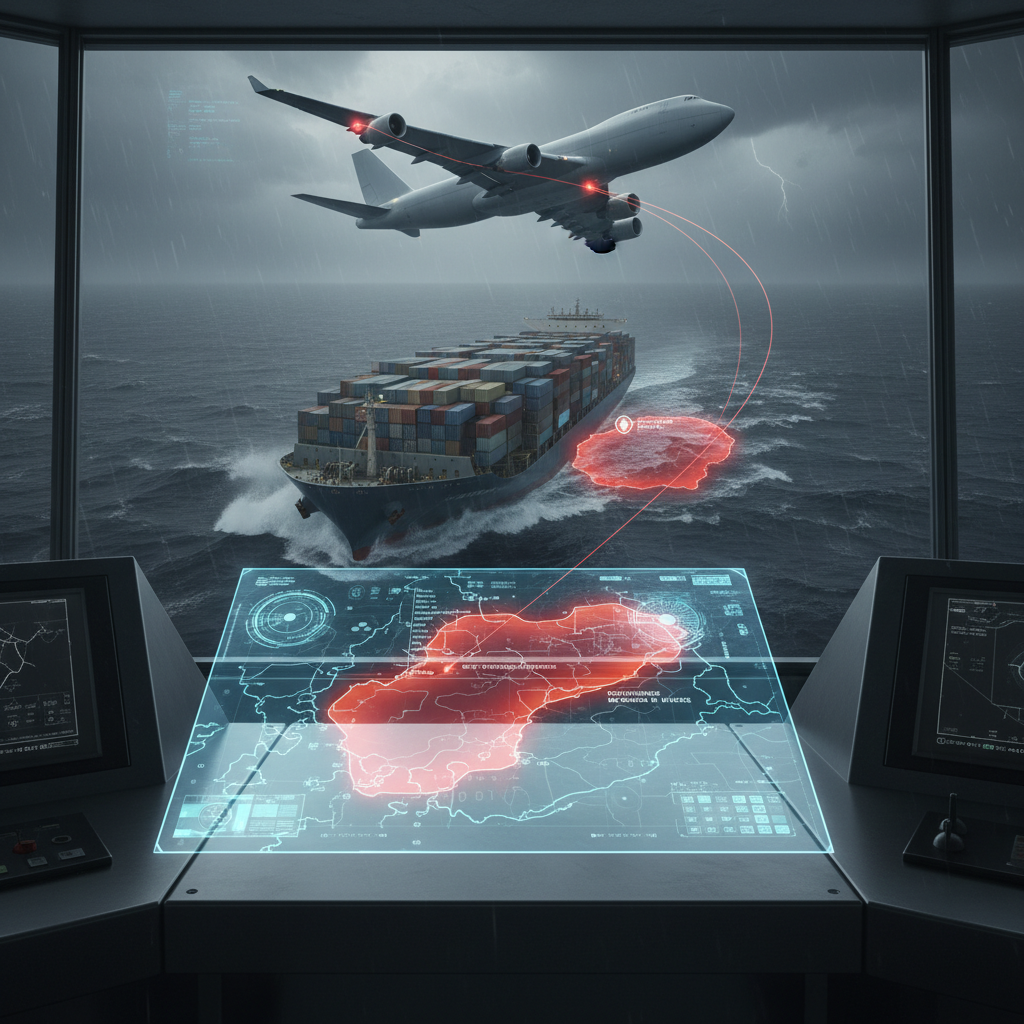
Impact on Routes and Transit Times
Geopolitical events are fundamentally reshaping global trade routes, moving away from efficiency-driven optimization towards resilience in the face of risk. When key maritime lanes or overland corridors become unsafe or inaccessible due to conflict or political instability, carriers are compelled to seek alternative paths. The ongoing conflict in Eastern Europe, for instance, has severely impacted traditional shipping lanes through the Black Sea, a critical artery for agricultural commodities like wheat. Vessels that once traversed these waters directly now face significant diversions, often adding thousands of miles to their journeys. These extended routes directly translate into increased fuel consumption, higher operational costs for shipping lines, and, crucially, significantly longer transit times for goods. A shipment that previously took weeks might now take months, disrupting manufacturing schedules, inflating inventory holding costs, and potentially leading to stockouts. The ripple effect extends beyond the immediate conflict zone, as redirected traffic can strain infrastructure in alternative ports and routes, creating new bottlenecks and exacerbating delays across the broader logistics network. Businesses are thus constantly challenged to identify and secure viable alternative routes, a complex task demanding real-time information and agile decision-making.
Airspace Restrictions and Overflight Bans
Geopolitical tensions frequently lead to airspace restrictions and outright overflight bans, profoundly impacting air cargo and passenger operations. When nations close their airspace to specific carriers or in response to regional conflicts, airlines are compelled to reroute flights around these forbidden zones. A prominent example is the extensive airspace closures over Eastern Europe and parts of Russia following recent geopolitical developments. Cargo aircraft, which rely on direct and efficient routes for time-sensitive deliveries, are now forced to fly significantly longer distances. These extended flight paths consume more jet fuel, driving up operational costs for air carriers, which are inevitably passed on to shippers as higher freight rates. Moreover, longer flight times reduce aircraft utilization and overall cargo capacity, as fewer rotations can be completed within a given period. This reduction in available air cargo capacity, coupled with increased demand for expedited shipping, creates bottlenecks in air logistics, leading to delays and further price inflation. For industries dealing with high-value, time-critical goods such as electronics or pharmaceuticals, these airspace restrictions pose a critical challenge, demanding agile planning and continuous monitoring to mitigate potential disruptions and maintain delivery commitments.
Waterway Disruptions and Maritime Security
Critical waterways and maritime chokepoints are particularly vulnerable to geopolitical events, with profound consequences for global trade. The Black Sea, as highlighted by the market's focus on wheat diplomacy, serves as a stark reminder of how regional conflicts can jeopardize essential shipping lanes. When a waterway becomes a conflict zone, or is perceived as high-risk, commercial shipping activity is severely curtailed. This can involve direct threats from military action, the presence of mines, or increased piracy and security risks. The immediate impact is a sharp increase in maritime insurance premiums for vessels operating in or near these areas, making trade prohibitively expensive for some commodities. Furthermore, ports within conflict zones may become inaccessible or operate under severe restrictions, leading to significant backlogs, cargo diversions, or outright cancellation of port calls. The disruption to major commodity flows, such as grain from the Black Sea region, can have global repercussions, affecting food security and driving up prices worldwide. Companies must navigate a complex landscape of risk assessment, potentially rerouting vessels around entire regions, increasing transit times, and incurring additional costs for security measures or higher insurance. Maintaining real-time visibility into vessel locations and potential threats becomes paramount for ensuring crew safety and cargo integrity.
Tariffs, Sanctions, and Trade Barriers
Beyond direct physical disruptions, geopolitical events frequently lead to the imposition of tariffs, sanctions, and other non-tariff trade barriers, fundamentally altering the economic landscape of global commerce. These measures, often enacted by governments to exert political pressure, have immediate and far-reaching consequences for supply chains. Sanctions can restrict the export or import of specific goods, prohibit transactions with certain entities or countries, or freeze assets, effectively cutting off entire markets. For example, sanctions against certain nations have forced companies to cease operations, find alternative suppliers or buyers, and reconfigure their entire sourcing and distribution networks. Tariffs, on the other hand, increase the cost of imported goods, making them less competitive and often leading to shifts in manufacturing locations or sourcing strategies. The commodity market, particularly for goods like wheat, is highly sensitive to such barriers, as they can disrupt established trade flows, create artificial scarcities, and drive price volatility. Businesses must navigate a complex web of international regulations, ensuring compliance while simultaneously seeking new market opportunities and diversifying their supply bases to mitigate dependency on politically sensitive regions. This requires continuous monitoring of geopolitical developments and their potential impact on trade policy.
Commodity Price Volatility and Supply Chain Resilience
Geopolitical instability is a significant driver of commodity price volatility, creating an environment of uncertainty that challenges supply chain planning and resilience. The market's anticipation of diplomatic efforts concerning the conflict in Eastern Europe, and its direct impact on Euronext wheat prices, illustrates this dynamic perfectly. When key producing or transit regions for essential commodities are affected by conflict or political tension, the perceived risk to supply immediately influences global prices. This volatility makes forecasting, budgeting, and procurement incredibly difficult for businesses. Sudden price spikes can erode profit margins, while unpredictable price drops can lead to inventory valuation losses. To build resilience in such an environment, companies are increasingly focusing on supply chain diversification, exploring multiple sourcing options across different geographic regions to reduce reliance on any single, potentially vulnerable, supplier or route. Furthermore, strategic inventory management, including safety stock and buffer inventories, becomes crucial to absorb short-term supply shocks. However, this also carries increased holding costs. The overarching goal is to create a more robust and adaptable supply chain that can withstand unforeseen disruptions without compromising continuity of supply or financial stability.
MGS Control Tower for Enhanced Visibility and Agility
In this era of heightened geopolitical risk and supply chain disruption, a shipment-visibility control tower platform like MGS becomes an indispensable tool for businesses aiming to maintain operational continuity and strategic agility. By providing real-time, end-to-end visibility across the entire supply chain, MGS empowers organizations to proactively respond to the challenges outlined above. For instance, when airspace is closed or a waterway becomes dangerous, the control tower can instantly flag affected shipments, identify alternative routes, and provide updated estimated times of arrival (ETAs). This capability is critical for managing the extended transit times and increased costs associated with diversions. Furthermore, by integrating data from various sources – including carrier updates, weather patterns, and geopolitical risk intelligence – MGS can offer predictive insights into potential disruptions, allowing businesses to pre-emptively adjust inventory levels, re-route cargo, or engage alternative logistics partners. For managing commodity price volatility, real-time tracking of shipments and inventory in transit helps optimize stock levels and reduce exposure to market fluctuations. Ultimately, an MGS control tower transforms raw data into actionable intelligence, enabling supply chain professionals to make informed decisions rapidly, mitigate risks, ensure compliance with evolving trade regulations, and build a truly resilient and responsive global logistics network in the face of persistent geopolitical headwinds.
Source: Maritime Professional — https://www.maritimeprofessional.com/news/wheat-falls-further-market-awaits-422700