
Europe's Inland Waterways Crisis: Navigating Supply Chain Disruptions and Rising Costs
Record-low water levels on the Rhine, coupled with restricted rail and road capacity, are creating significant operational pressures on European inland transport. This analysis explores the global supply chain and financial impacts, and how advanced visibility platforms can help mitigate risks.
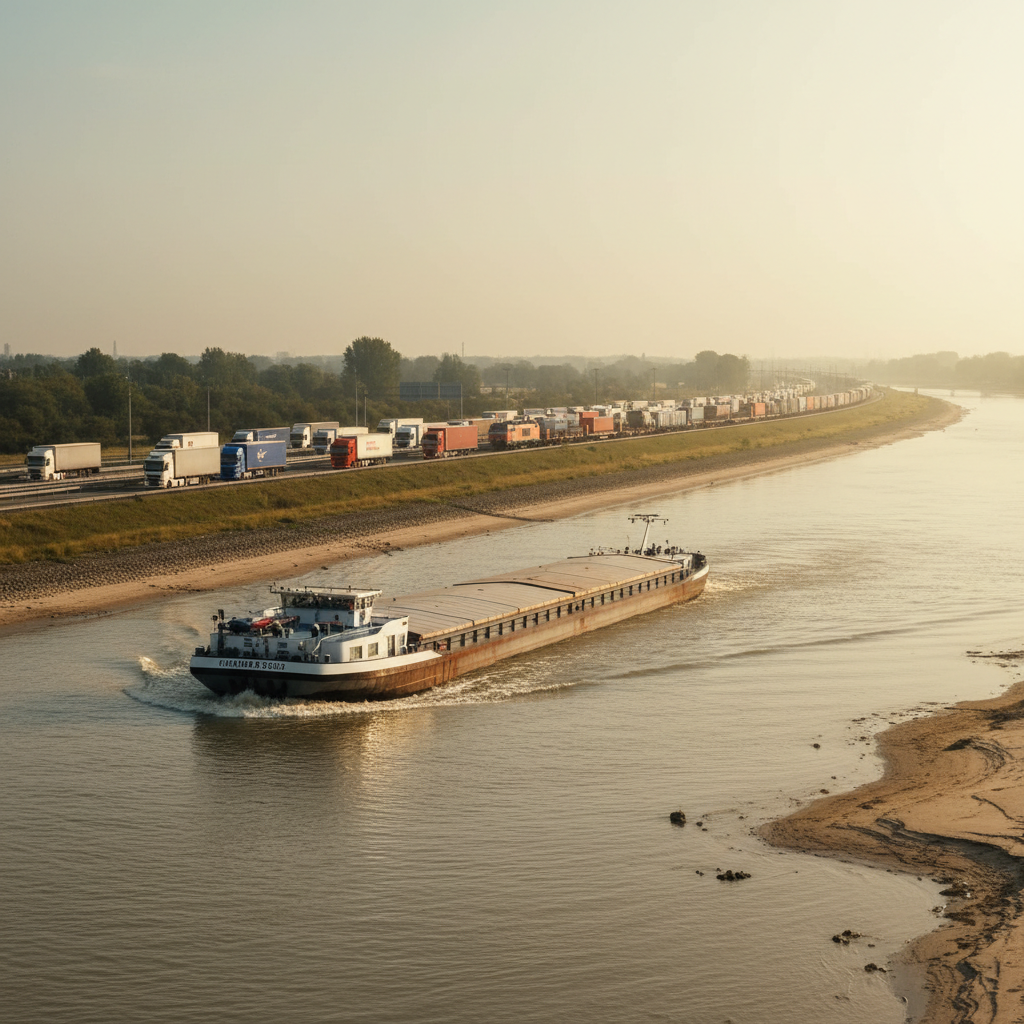
How this impacts the global supply chain
The current challenges facing Europe's inland transport networks, particularly the critical Rhine waterway, are sending ripples far beyond regional borders, profoundly impacting global supply chain flows, routes, capacity, and operational efficiency. The confluence of record-low Rhine water levels, restricted rail capacity, and limited road alternatives creates a bottleneck effect that reverberates through international trade. Goods typically moved efficiently by barge along the Rhine, a vital artery connecting major industrial hubs in Germany, the Netherlands, and Switzerland to global ports, are now facing severe delays or requiring costly re-routing. This directly affects the flow of raw materials into manufacturing centers and finished goods out to export markets.
The immediate impact on routes is a forced shift away from the most economical and environmentally friendly modes. With river transport severely hampered, logistics operators are compelled to seek alternatives. However, the source highlights that rail capacity is already restricted, and road options are limited. This means that even if alternative routes are found, they are likely to be longer, less direct, and subject to their own capacity constraints. This can lead to congestion at alternative transport hubs, further exacerbating delays. For global supply chains, this translates into extended lead times for goods moving in and out of Europe, potentially disrupting production schedules for companies worldwide that rely on European components or supply European markets.
Overall capacity within the European inland transport network is significantly diminished. The inability to fully utilize the Rhine's capacity, combined with pre-existing limitations on rail and road, means that the total volume of goods that can be moved efficiently is reduced. This scarcity of reliable transport capacity drives up competition for available slots and resources, creating a seller's market for logistics services. Operationally, businesses are facing increased complexity. Planning and execution become more challenging as traditional, predictable routes are no longer viable. Companies must invest more time and resources into contingency planning, finding alternative carriers, and managing the increased risk of disruptions. The pressure on raw materials, as noted in the source, indicates that manufacturing operations could face input shortages, leading to production slowdowns or even stoppages, which then cascade into global product availability issues.
Global financial impact
The operational pressures on Europe's inland transport networks translate directly into significant financial and cost implications for all stakeholders across the global trade ecosystem. Shippers, who rely on these networks to move their goods, are immediately confronted with higher freight rates. The scarcity of reliable capacity on river, rail, and road means that the cost of moving goods increases substantially. This is not merely an incremental rise; the shift from cost-effective barge transport to more expensive road or even air freight for urgent shipments can dramatically inflate logistics budgets. Beyond direct transport costs, shippers face increased inventory holding costs due to longer transit times and unpredictable delivery schedules. Delays can lead to missed delivery windows, potentially incurring penalties or damaging customer relationships. The pressure on raw materials also implies higher procurement costs for manufacturers, as supply becomes tighter and more expensive to transport.
For carriers, while the immediate observation might be 'higher rates,' the reality is more nuanced. While they can charge more for their services, their operational costs also escalate. Longer journeys, increased fuel consumption due and potential empty backhauls for repositioning equipment, and the administrative burden of managing complex re-routings all eat into potential profits. The efficiency of their networks is compromised, meaning that even with higher rates, their overall profitability might not see a proportional increase, especially if they are struggling to maintain service levels and asset utilization. The limited alternatives mean that even carriers operating on rail or road are under immense pressure, leading to increased wear and tear on equipment and potential driver shortages due to extended routes and hours.
At the broader trade level, these increased costs contribute to inflationary pressures on goods. When the cost of moving raw materials and finished products rises, these expenses are often passed on to the end consumer, impacting purchasing power and potentially dampening demand. The economic stability of regions heavily reliant on the affected transport corridors, such as Germany, the Netherlands, and Switzerland, could be undermined if industrial output is hampered by raw material shortages or prohibitive logistics costs. This could lead to a slowdown in economic activity, affecting global trade volumes and investment. The cumulative effect of higher rates, longer journeys, and pressure on raw materials creates a challenging environment that demands strategic financial planning and agile response mechanisms from businesses engaged in international trade.
How MGS can help navigate today's global trade environment
In an environment characterized by record-low water levels, restricted capacity, and escalating costs, a shipment-visibility control tower like MGS becomes an indispensable tool for operators navigating Europe's disrupted inland transport. The core value MGS provides is real-time, end-to-end visibility, which is paramount when traditional logistics pathways are compromised. When a planned barge shipment on the Rhine is delayed or cancelled due to worsening navigational conditions, MGS can immediately flag this disruption. Operators gain instant insight into the exact location and status of their cargo, allowing them to understand the scope of the problem without relying on manual updates or fragmented information.
This immediate visibility empowers proactive decision-making. Instead of reacting to a crisis after it has fully unfolded, MGS enables operators to anticipate issues. For instance, by integrating data on Rhine water levels or rail network congestion, MGS can provide early warnings about potential delays, allowing logistics teams to explore alternative transport modes or routes before a shipment is critically impacted. This might involve re-routing goods from river to available, albeit limited, rail or road capacity, or even considering different port entry points if inland movement from traditional hubs becomes unfeasible. MGS can help model the cost and time implications of these alternative scenarios, providing data-driven insights to select the most viable option.
Furthermore, the pressure on raw materials highlighted in the source underscores the need for precise inbound logistics management. MGS offers granular visibility into the movement of critical raw materials, enabling manufacturers to monitor their supply pipeline closely. If a shipment of essential components is stuck due to inland transport issues, MGS can alert production planners, allowing them to adjust schedules, prioritize orders, or even source from alternative suppliers to prevent costly production line stoppages. By centralizing communication and providing a single source of truth for shipment data, MGS streamlines collaboration between shippers, carriers, and other logistics partners, ensuring everyone is working from the same, up-to-date information, which is crucial for coordinating complex re-routing efforts and managing stakeholder expectations in a volatile operational landscape.
Demand–supply analysis & improvement
The current situation in Europe's inland transport vividly illustrates a severe imbalance between demand and supply. Demand for efficient and reliable freight movement across Germany, the Netherlands, and Switzerland remains consistently high, driven by robust industrial activity and consumer markets. However, the supply of available capacity on key modes is significantly constrained. Record-low Rhine water levels drastically reduce the carrying capacity of barges, forcing them to lighten loads or cease operations entirely. Simultaneously, existing restrictions on rail capacity and the inherent limitations of road alternatives mean that the available supply of transport options cannot meet the underlying demand. This fundamental imbalance is the primary driver behind the 'higher rates' and 'longer journeys' observed.
To address this demand-supply dynamic and foster improvement, several concrete levers can be pulled. Firstly, diversification of transport modes becomes paramount. Companies traditionally reliant on river transport must actively explore and qualify a broader portfolio of logistics solutions, even if they are initially less efficient or more costly. This might involve a strategic shift towards intermodal solutions that combine short-sea shipping with rail, or leveraging smaller, more agile road carriers for specific segments. Secondly, optimized routing and network design is crucial. Instead of simply trying to replicate old routes with new modes, operators should re-evaluate their entire logistics network, identifying new hubs or consolidation points that bypass the most constrained areas. This requires a data-driven approach to identify bottlenecks and opportunities.
Thirdly, strategic inventory management can act as a buffer against supply shocks. While not a direct transport solution, increasing safety stock for critical raw materials, as mentioned in the source, can mitigate the immediate impact of transport delays on production. This requires a careful balance to avoid excessive holding costs. Fourthly, enhanced collaboration and information sharing with logistics partners is vital. By working closely with carriers, freight forwarders, and even competitors, companies can pool resources, share capacity, and collectively find solutions. Finally, leveraging technology for predictive insights can significantly improve responsiveness. A platform like MGS can provide real-time data on capacity availability, congestion points, and even environmental factors like water levels, enabling operators to anticipate disruptions and make proactive adjustments to their demand-supply matching strategies, thereby mitigating the impact of these systemic imbalances.
ROI-focused resilience
Investing in supply chain resilience, particularly in the face of disruptions like Europe's inland transport crisis, can be framed directly in terms of return on investment (ROI). The 'higher rates, longer journeys, and pressure on raw materials' described in the source represent quantifiable risks that can erode profitability and market share. Resilience actions, such as implementing a robust shipment visibility control tower like MGS, offer a clear protective investment against these risks.
Consider the quantified risks: Increased freight costs are a direct financial hit. If a company typically spends X on freight, and rates increase by 20% due to re-routing from river to road, that 20% increase is a direct cost. An MGS platform, by enabling proactive re-routing and optimizing mode selection, can help mitigate these increases, potentially saving a percentage of that additional cost. For example, preventing a single emergency air freight shipment by enabling a planned, albeit longer, road alternative could save tens of thousands of dollars.
Production stoppages due to raw material shortages represent a significant financial risk. The cost of a manufacturing line being idle for a day can run into hundreds of thousands or even millions of dollars, not to mention lost sales and reputational damage. By providing real-time visibility into inbound raw material shipments and alerting operators to potential delays, MGS allows for proactive adjustments to production schedules or alternative sourcing, thereby preventing or significantly shortening costly downtime. The ROI here is the avoided cost of a production halt, which can easily justify the platform's investment many times over.
Demurrage and detention charges at ports or terminals due to delayed inland collection or onward movement are another quantifiable risk. These charges can quickly accumulate, adding unexpected costs to a shipment. With MGS, operators have the visibility to anticipate delays and coordinate with terminals and carriers to minimize or avoid these penalties. Furthermore, customer dissatisfaction and lost sales due to missed delivery windows are harder to quantify but have a profound long-term impact. Maintaining delivery reliability through proactive disruption management, facilitated by MGS, protects revenue streams and preserves customer loyalty. The investment in MGS, therefore, is not just an operational expense but a strategic safeguard against significant financial losses, ensuring business continuity and protecting the bottom line in an increasingly volatile global trade environment.
Source: The Loadstar — https://theloadstar.com/europes-inland-transport-higher-rates-longer-journeys-and-pressure-on-raw-materials/