
Carrier-Agnostic Visibility: Solving Multi-Carrier Data Normalization
Every carrier names fields differently and reports out of order. Carrier-agnostic normalization turns fragmented feeds into one trustworthy shipment view.
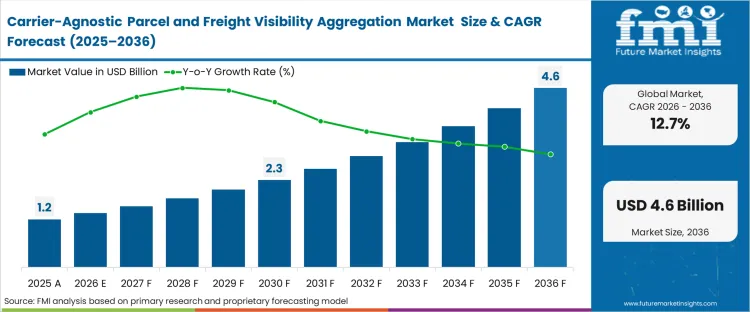
The carrier-agnostic parcel and freight visibility aggregation market was valued at approximately USD 1.2 billion in 2025. Analysts project it reaching USD 4.6 billion by 2036, expanding at a compound annual growth rate of 12.7%. The number behind that forecast is less interesting than the underlying problem it describes: shippers and 3PLs are spending money at scale to solve a data quality problem that should not exist, but does.
Every carrier reports the same physical reality — a container moving through a port, a parcel out for delivery, a truck delayed at a customs crossing — using different field names, different status codes, different timestamp formats, and different event sequences. The result is that an organisation managing relationships with five carriers is effectively managing five incompatible data streams that happen to describe the same supply chain.
What Carrier Schema Fragmentation Actually Costs
The direct costs are integration engineering hours. Each new carrier relationship requires custom mapping work: understanding what the carrier calls the field that another carrier calls something different, handling the cases where the carrier does not report certain events at all, writing validation logic to catch the cases where the carrier reports events out of chronological order.
The indirect costs are harder to measure and larger in aggregate. Operational decisions that should be automated — triggering an exception alert when a shipment misses a milestone, updating a delivery ETA when a delay event arrives — require manual handling when the underlying event data cannot be trusted to arrive in a consistent format. Analytics that require cross-carrier comparison, like measuring on-time delivery rates across a carrier portfolio, become engineering projects rather than dashboard queries.
The Future Market Insights research identifies data heterogeneity from regional operators as a primary constraint on predictive tracking capabilities. Machine learning models trained to forecast ETAs or identify delay patterns require clean, consistent input data. When IT teams spend their engineering cycles scrubbing inconsistent carrier data rather than building on top of it, predictive capabilities remain aspirational rather than operational.
The Platform Software Layer
The research notes that platform software holds 68% of the carrier-agnostic visibility market by revenue share — a figure that reflects where the value in the ecosystem actually sits. Point integrations with individual carriers are commodity work. The intelligence layer that normalises, validates, and enriches data across all of them is where durable competitive advantage accumulates.
This platform layer performs several distinct functions. Schema normalisation maps disparate carrier field names and status codes onto a consistent internal data model. Sequence validation detects and handles events that arrive out of order. Enrichment layers add context that carriers do not provide — calculating estimated arrival windows based on historical transit performance, flagging anomalous events that suggest data quality issues rather than actual shipment status changes.
The 46% multimodal share identified in the research reflects the particular complexity of shipments that cross modal boundaries — a container moving from ocean freight to rail to last-mile delivery, each segment managed by a different carrier with its own reporting format. Stitching those segments into a single coherent shipment timeline requires the platform layer to hold the complete milestone sequence and understand which events belong to which segment.
Regional Fragmentation and the Long Tail of Carriers
The research highlights India's 15.1% regional growth rate as driven by massive fragmentation across owner-operator fleets, where logistics planners need API normalisation layers to process inconsistent reporting from tier-three transport providers. China's 14.2% growth is linked to port authority mandates for real-time telematics feeds. Both dynamics point to the same pattern: as visibility mandates extend down the carrier long tail, the normalisation problem intensifies before it simplifies.
Large enterprise carriers typically maintain reasonably documented APIs because they serve large shippers who demand them. Regional carriers, owner-operators, and specialist logistics providers often have no structured API at all, or have APIs that were built for internal use and lack the consistency expected by an integration layer. Aggregation platforms that can ingest data from these providers — whether via structured API, EDI, email parsing, or manual updates — without exposing that inconsistency to the consuming application represent a qualitatively different capability than integrations that assume carrier API quality.
Predictive ETA as the Downstream Beneficiary
The research identifies predictive ETA modules as holding 34% application share, driven by detention fee pressure and the need to synchronise dock door labour availability with incoming freight coordinate data. The predictive capability is entirely dependent on the quality of the normalised event stream underneath it.
A model predicting arrival times from a carrier that reports milestone events inconsistently will produce unreliable predictions. The cleaning and normalisation work that aggregation platforms perform is therefore not infrastructure overhead — it is the prerequisite for every higher-order analytical capability that supply chain teams want to deploy. Exception management, predictive ETA, carrier performance benchmarking, and SLA dispute resolution all consume the normalised event stream as their primary input.
Multi-carrier visibility platforms that treat milestone normalisation as a core competency rather than a preprocessing step are building the foundation for these analytical capabilities in a way that per-carrier integrations cannot replicate. The control tower architecture, at its most useful, is a normalisation layer that turns fragmented carrier feeds into one trustworthy shipment record across all carriers, all modes, and all geographies.
Source: Future Market Insights