
Calculated Risk: Major Carriers Recommit to Suez Amidst Lingering Red Sea Threats
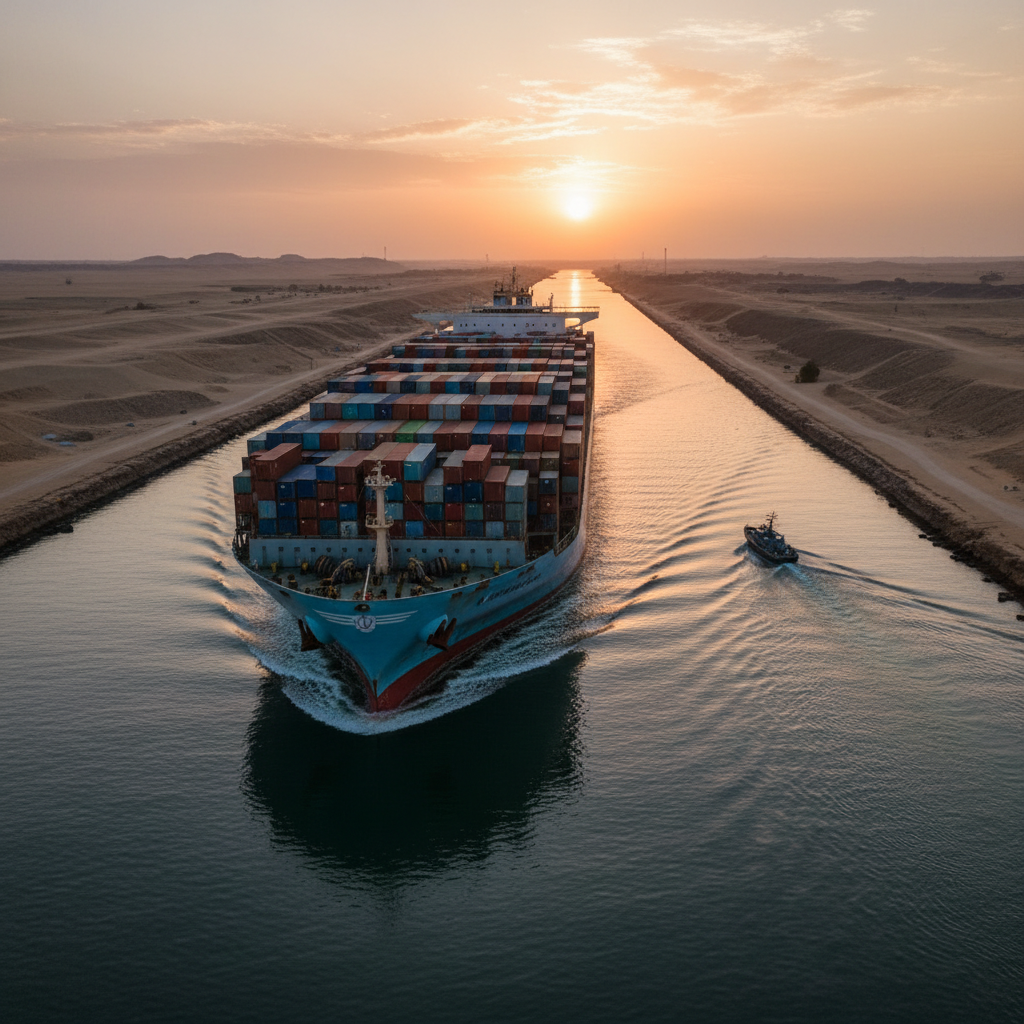
Maersk and Hapag-Lloyd are strategically increasing their Suez Canal transits for Gemini Cooperation services, signaling a complex trade-off between operational efficiency and persistent geopolitical risks in the Red Sea.
How this impacts the global supply chain
The decision by major carriers like Maersk and Hapag-Lloyd to expand their use of the Suez Canal for Gemini Cooperation services, despite ongoing Red Sea risks, marks a significant shift in global supply-chain dynamics. This move primarily impacts global flows and routes by reverting a substantial portion of Asia-Europe trade back to its traditional, shorter pathway. This reduces transit times significantly compared to the alternative route around the Cape of Good Hope, which adds thousands of nautical miles and weeks to voyages. However, it also concentrates a high volume of global trade through a critical chokepoint, inherently increasing vulnerability to disruption.
In terms of capacity, the shorter Suez route allows vessels to complete more round trips within a given period. This effectively increases the deployed shipping capacity without requiring additional ships, potentially easing pressure on vessel availability and contributing to a more fluid global network. Operationally, this signifies a calculated risk assessment by the carriers. It necessitates a highly dynamic approach to network planning, with constant monitoring of the geopolitical situation in the Red Sea. While aiming for greater efficiency, it also implies the need for robust contingency plans, the potential for sudden diversions, and heightened security protocols. For shippers, this means a potential return to faster delivery schedules but also a persistent undercurrent of uncertainty, requiring enhanced agility in their own logistics and inventory management strategies.
Global financial impact
The financial implications of this strategic shift are multifaceted for all stakeholders. For carriers like Maersk and Hapag-Lloyd, the primary driver is likely substantial cost savings. The Suez Canal route offers significant reductions in fuel consumption and faster asset utilization, allowing vessels to generate revenue more frequently. These operational efficiencies directly contribute to improved profitability. However, these savings come at the cost of increased exposure to Red Sea risks, which can translate into higher insurance premiums, potential security surcharges, and the financial burden of potential vessel damage, cargo loss, or crew safety incidents. The decision reflects a judgment that the efficiency gains outweigh these heightened risk-related expenditures.
Shippers, in turn, may see a positive financial impact through potentially lower freight rates, driven by the increased effective capacity and reduced operating costs for carriers. Faster transit times could also lead to lower inventory holding costs and improved cash flow due to quicker delivery of goods. However, these benefits could be partially offset by increased cargo insurance premiums for transiting high-risk areas or by carrier-imposed surcharges to cover enhanced security measures. For global trade at large, a more efficient Suez route generally supports trade volumes by reducing the time and cost of moving goods between major economic blocs. Yet, the underlying instability in the Red Sea means these financial gains are fragile. Any major incident could trigger renewed diversions, leading to significant economic disruption, price volatility, and supply chain bottlenecks, impacting global inflation and economic growth.
How MGS can help navigate today's global trade environment
In an environment where major carriers are making calculated risk decisions like expanding Suez Canal transits despite ongoing threats, the need for real-time, granular shipment visibility becomes paramount. A shipment-visibility control tower like MGS is uniquely positioned to help operators navigate this complex global trade environment.
MGS provides end-to-end tracking of shipments, allowing operators to monitor their cargo's exact location, especially as vessels traverse high-risk zones within the Suez Canal and Red Sea. This real-time visibility is crucial for proactive risk management. MGS can integrate geopolitical alerts, weather patterns, and carrier updates, enabling operators to identify potential disruptions before they impact their cargo. This means MGS can flag vessels approaching areas of heightened risk or anticipate potential diversions, facilitating proactive communication with customers and internal stakeholders.
Furthermore, in the event of a Red Sea incident or renewed threats, MGS data allows operators to immediately assess which specific shipments are affected, identify viable alternative routes (e.g., around the Cape of Good Hope), and recalculate estimated times of arrival (ETAs) with precision. This capability is vital for mitigating financial penalties, managing customer expectations, and maintaining supply chain integrity. By providing a single source of truth for all shipment data, MGS empowers logistics teams to make informed, data-driven decisions about inventory levels, warehousing, and downstream transportation, enabling them to adapt swiftly to changes in transit times or routes and effectively balance the trade-off between speed and risk that carriers are currently navigating.
Demand–supply analysis & improvement
The expansion of Suez Canal returns by Maersk and Hapag-Lloyd directly impacts the supply side of global shipping. By utilizing the shorter Suez route, carriers effectively increase the available shipping capacity without deploying additional vessels. This is because each vessel can complete more round trips between Asia and Europe within the same timeframe, thereby increasing the frequency and volume of goods that can be transported. This increased effective capacity could help to ease pressure on freight rates, which have been volatile due to past disruptions. For shippers, this means potentially more options and competitive pricing.
Improvement Levers:
- For Carriers: The strategy represents an optimization of their existing fleet, aiming for maximum asset utilization and fuel efficiency. Continuous monitoring of geopolitical stability and swift adaptation of service networks are key improvement levers to sustain this efficiency while managing risk.
- For Shippers: This development allows for potential improvements in inventory management through shorter lead times. However, it also necessitates enhanced vigilance over carrier routing decisions and robust contingency planning. Shippers should leverage data analytics to evaluate the reliability and risk profile of different carrier services and routes, ensuring their supply chain remains agile enough to pivot if Red Sea risks escalate again.
ROI-focused resilience
The decision by Maersk and Hapag-Lloyd to expand Suez transits despite acknowledged Red Sea risks is a prime example of a calculated ROI-driven resilience strategy. The 'investment' here is the acceptance of heightened security risks and potential for disruption, in exchange for significant operational and financial returns.
Quantified Risk vs. Return:
- Risk: The quantifiable risks include increased insurance premiums, potential vessel damage or loss, crew safety threats, and the financial penalties associated with delays or cargo loss due to security incidents. A single major incident could lead to millions in direct costs (e.g., salvage, repairs, claims) and indirect costs (e.g., reputational damage, lost future business).
- Return: The primary return is substantial fuel savings and faster transit times. Diverting around the Cape of Good Hope adds thousands of nautical miles and weeks to a journey, significantly increasing fuel consumption and reducing vessel utilization. The Suez route offers millions in fuel savings per vessel per year and allows for more frequent service, enhancing revenue potential.
MGS's Role in ROI-focused Resilience: A shipment-visibility control tower like MGS contributes directly to this ROI calculation by enhancing resilience.
- Risk Mitigation ROI: MGS provides real-time alerts and visibility into vessels' proximity to risk zones. This allows for proactive measures, potentially preventing incidents or minimizing their impact. The ROI is seen in avoided costs from delays, damages, or rerouting. For example, if MGS helps reroute a critical shipment away from an impending incident, saving days of delay and potential loss, the ROI is the value of that avoided disruption.
- Operational Efficiency ROI: By providing accurate ETAs and performance data, MGS helps optimize inventory levels, reducing holding costs. It also enables faster response times during disruptions, minimizing the financial impact of unforeseen events. The ROI is measured in reduced inventory costs, lower demurrage charges, and improved customer satisfaction, which translates to sustained revenue.
- Informed Decision-Making ROI: MGS provides the data needed to continually assess the risk-reward balance of routes like the Suez Canal. By analyzing historical performance and real-time conditions, operators can make data-driven decisions on route selection, carrier choice, and insurance coverage, ensuring that their resilience investments yield the best possible returns.
Source: Global Trade Magazine — https://www.globaltrademag.com/maersk-hapag-lloyd-expand-suez-canal-return-despite-red-sea-risks/