
Bridging the Orchestration Gap: How Disconnected Automation Stalls Global Supply Chains
Advanced warehouse automation promises efficiency, but a critical 'orchestration gap' can turn futuristic facilities into bottlenecks. This brief explores how disconnected systems impact global supply chains, drive up costs, and how real-time visibility can help operators navigate these challenges.
How this impacts the global supply chain
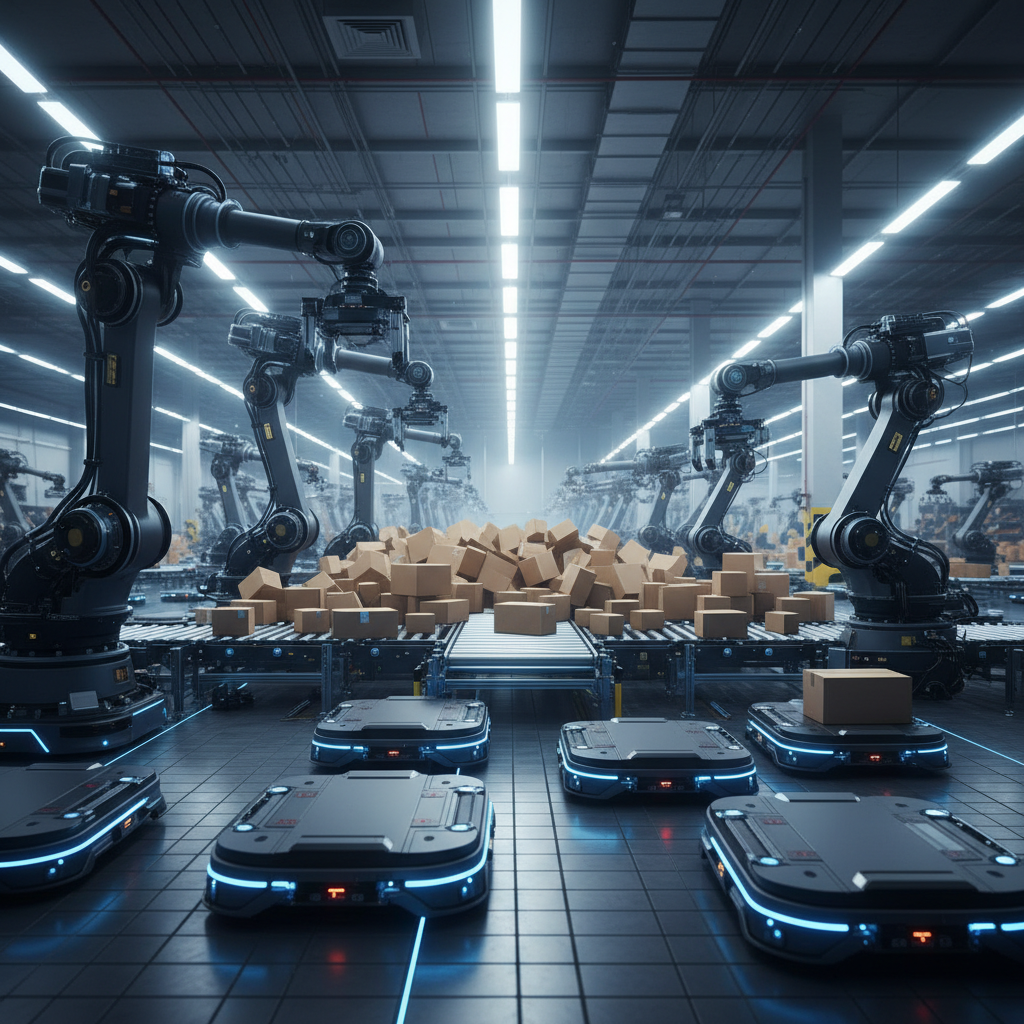
The promise of advanced warehouse automation – robotic piece-pickers, Autonomous Mobile Robots (AMRs), and automated sorters – is to revolutionize logistics by dramatically increasing speed and efficiency. However, as the concept of an 'orchestration gap' highlights, merely deploying these sophisticated technologies isn't enough. When these systems fail to communicate and coordinate effectively, the resulting bottlenecks and 'tanking throughput' within individual facilities create significant ripple effects across the entire global supply chain.
Firstly, the smooth flow of goods is severely disrupted. Products that should be moving swiftly through a distribution center become stalled, leading to delays in onward shipments to retailers, other warehouses, or directly to consumers. This internal congestion translates into longer lead times for the entire supply chain, making it harder to meet delivery promises and impacting customer satisfaction. The unpredictability introduced by these internal delays can force supply chain managers into reactive modes, constantly adjusting schedules and re-prioritizing shipments.
While not directly altering physical routes, the delays caused by inefficient warehouse operations can indirectly influence routing decisions. If a critical shipment is held up at a fulfillment center, businesses might be compelled to switch to more expensive, faster modes of transport, such as air freight, for subsequent legs to compensate for lost time. This not only increases transportation costs but also adds complexity and environmental impact to the supply chain network.
Regarding capacity, the effective capacity of a warehouse or fulfillment center is significantly diminished. A facility designed to process a certain volume of goods per hour might only achieve a fraction of that due to internal bottlenecks at points like the 'induction point.' This underutilization of expensive assets means that the actual throughput capacity is far below the theoretical maximum, leading to backlogs and potentially requiring businesses to seek additional, unplanned storage or processing space. This hidden reduction in capacity can strain the entire network, especially during peak seasons.
Finally, global supply chain operations suffer from increased unpredictability and inefficiency. The 'orchestration gap' necessitates more manual intervention to troubleshoot and resolve issues, negating the labor-saving benefits of automation. This leads to higher operational costs, increased human error, and a general erosion of reliability. For global trade, this means less predictable inventory levels, higher safety stock requirements to buffer against uncertainty, and a reduced ability to respond quickly to market changes or customer demands, ultimately hindering overall supply chain agility and resilience.
Global financial impact
The 'orchestration gap' within automated warehouses carries substantial financial and cost implications that reverberate throughout the global trade ecosystem, affecting shippers, carriers, and the broader economy.
For shippers, the financial burden is multifaceted. Firstly, there are increased operating costs. Bottlenecks and reduced throughput mean that expensive automated equipment is not being utilized to its full potential, leading to a poor return on investment. Furthermore, despite automation, the need for manual intervention to resolve issues or manage backlogs can drive up labor costs, including overtime. Secondly, and perhaps most critically, are lost sales and revenue. Delays in fulfilling orders directly translate to missed market opportunities, especially in fast-paced e-commerce environments where customer expectations for rapid delivery are high. Customers may abandon purchases or switch to competitors if delivery promises are consistently unmet. Thirdly, to mitigate the risk of these internal delays, shippers often resort to holding larger safety stocks, tying up significant capital in inventory and incurring higher storage, insurance, and potential obsolescence costs. Lastly, the pressure to meet deadlines often forces shippers to use more expensive expedited shipping methods, such as air freight, to compensate for internal warehouse inefficiencies, dramatically increasing transportation expenses.
Carriers also bear financial consequences. They face increased dwell times at inefficient warehouses, as trucks and other transport vehicles wait longer for loading or unloading. This leads to demurrage charges, reduced asset utilization (trucks and drivers sitting idle), and lower overall driver productivity. Unpredictable warehouse operations can disrupt carrier schedules, causing cascading delays across their networks and potentially leading to penalties for failing to meet service level agreements with other clients. This inefficiency can strain carrier-shipper relationships and increase the cost of doing business.
For trade at large, the cumulative effect of these inefficiencies is significant. The overall velocity of goods moving through the global trade system slows down, meaning capital is tied up longer in transit or storage, reducing economic efficiency. Persistent delays and unpredictability can erode trust and reliability within the global supply chain, making it a less attractive environment for investment and fostering a preference for localized, albeit potentially more expensive, sourcing. Ultimately, the increased operational costs for shippers and carriers, coupled with higher inventory holding costs and expedited shipping, contribute to higher prices for consumers. The promise of automation to drive down costs and improve efficiency is undermined, leading to a net increase in the cost of goods and potentially fueling inflationary pressures across various sectors of the global economy.
How MGS can help navigate today's global trade environment
In an environment where advanced warehouse automation can paradoxically create bottlenecks due to an 'orchestration gap,' a shipment-visibility control tower like MGS plays a crucial role in providing the necessary oversight and actionable insights, even if it doesn't directly manage internal warehouse robotics.
Firstly, MGS offers real-time bottleneck identification at a macro level. While it may not see the exact communication failure between an AMR and a sorter, it can clearly show that a specific distribution center is consistently failing to meet its expected processing times for inbound or outbound shipments. By aggregating data from various points in the supply chain – from port arrivals to final mile delivery – MGS can highlight where goods are getting stuck. This external visibility acts as an early warning system, indicating that an internal 'orchestration gap' or similar operational inefficiency is impacting the overall flow of goods through that node.
Secondly, the platform enables robust performance monitoring and anomaly detection. MGS tracks expected versus actual shipment processing times at critical nodes, including warehouses. If a facility that typically processes goods within a standard timeframe suddenly experiences prolonged delays, MGS will flag this deviation. This signals a potential problem, such as an orchestration gap, even if the precise internal cause isn't visible within the control tower itself. This allows operators to quickly identify underperforming facilities and initiate investigations into the root cause, rather than waiting for customer complaints or downstream disruptions.
Thirdly, MGS facilitates proactive risk mitigation. Once delays originating from a specific facility are identified, the control tower empowers supply chain managers to take immediate, informed action. This could involve rerouting subsequent shipments to alternative, more efficient warehouses, adjusting inventory levels at other locations to compensate for the shortfall, or proactively communicating revised delivery expectations to affected customers. This ability to anticipate and react to internal operational issues significantly mitigates their downstream impact on the broader supply chain.
Finally, by providing a comprehensive, shared view of shipment status and potential delays, MGS fosters improved collaboration and communication across the supply chain ecosystem. Different departments within an organization (e.g., logistics, sales, procurement) and external partners (carriers, suppliers) can access the same real-time data. This single source of truth ensures everyone is working with the most current information, enabling coordinated responses to issues stemming from internal operational inefficiencies and preventing miscommunication or blame games. This data-driven approach supports more strategic decision-making, from prioritizing urgent orders to informing future investments in warehouse technology integration.
Demand–supply analysis & improvement
The 'orchestration gap' directly reveals a critical imbalance in demand-supply dynamics within the operational heart of logistics: the warehouse. The source explicitly states that "overall throughput is tanking" and "a bottleneck is forming at the induction point." This scenario perfectly illustrates a failure in the supply side of the internal warehouse operation to meet the demand placed upon it.
The advanced machinery – robotic piece-pickers, AMRs, and automated sorters – represents significant potential supply capacity. These systems are designed to process a high volume of goods efficiently. However, the lack of communication and coordination, the 'orchestration gap,' prevents this potential supply from being realized. The bottleneck at the induction point means that inbound goods (representing demand for processing) cannot be moved into the system efficiently, and outbound orders (representing demand for fulfillment) cannot be picked, sorted, and dispatched at the expected rate. The facility's actual output, its effective supply, is severely constrained, leading to a mismatch with the operational demand.
To address this, several concrete improvement levers can be pulled:
Firstly, the most direct lever is integration software. Implementing a robust Warehouse Execution System (WES) or Warehouse Control System (WCS) is paramount. These intelligent software layers are designed to orchestrate the activities of disparate automated systems, ensuring they 'talk to each other' and work in concert. This involves real-time data exchange, task prioritization, and dynamic routing to eliminate bottlenecks and optimize flow.
Secondly, data standardization is crucial. For systems to communicate effectively, they must speak a common language. Ensuring consistent data formats and protocols across all automated equipment allows for seamless information flow regarding inventory location, task status, and equipment availability, which is essential for effective orchestration.
Thirdly, process optimization goes hand-in-hand with technology. The existence of bottlenecks often points to underlying inefficiencies in workflow design. Re-engineering internal processes to fully leverage the capabilities of integrated automation, rather than simply automating existing manual processes, can unlock significant throughput gains. This might involve re-evaluating induction procedures, picking strategies, or sorting logic.
Finally, predictive analytics and continuous monitoring offer proactive improvement. By analyzing historical data and real-time operational metrics, systems can anticipate potential bottlenecks based on inbound shipment volumes, order forecasts, and equipment performance. This allows for proactive adjustments to resource allocation or workflow, preventing throughput from tanking before it becomes a critical issue. Regular performance reviews and feedback loops are essential for continuous improvement and adapting to new operational challenges.
Source: Logistics Viewpoints — https://logisticsviewpoints.com/2026/09/08/bits-boxes-where-intelligent-software-meets-physical-fulfillment-the-orchestration-gap/