
Beyond the Network: Why Integrated Logistics is the New Imperative
The traditional view of logistics as a mere collection of interconnected functions falls short. True efficiency and customer satisfaction demand a holistic approach, unifying transportation, warehousing, and last-mile operations into a single, cohesive outcome. This brief explores the profound impact of siloed logistics management and how end-to-end visibility platforms are essential for navigating today's complex global trade landscape.
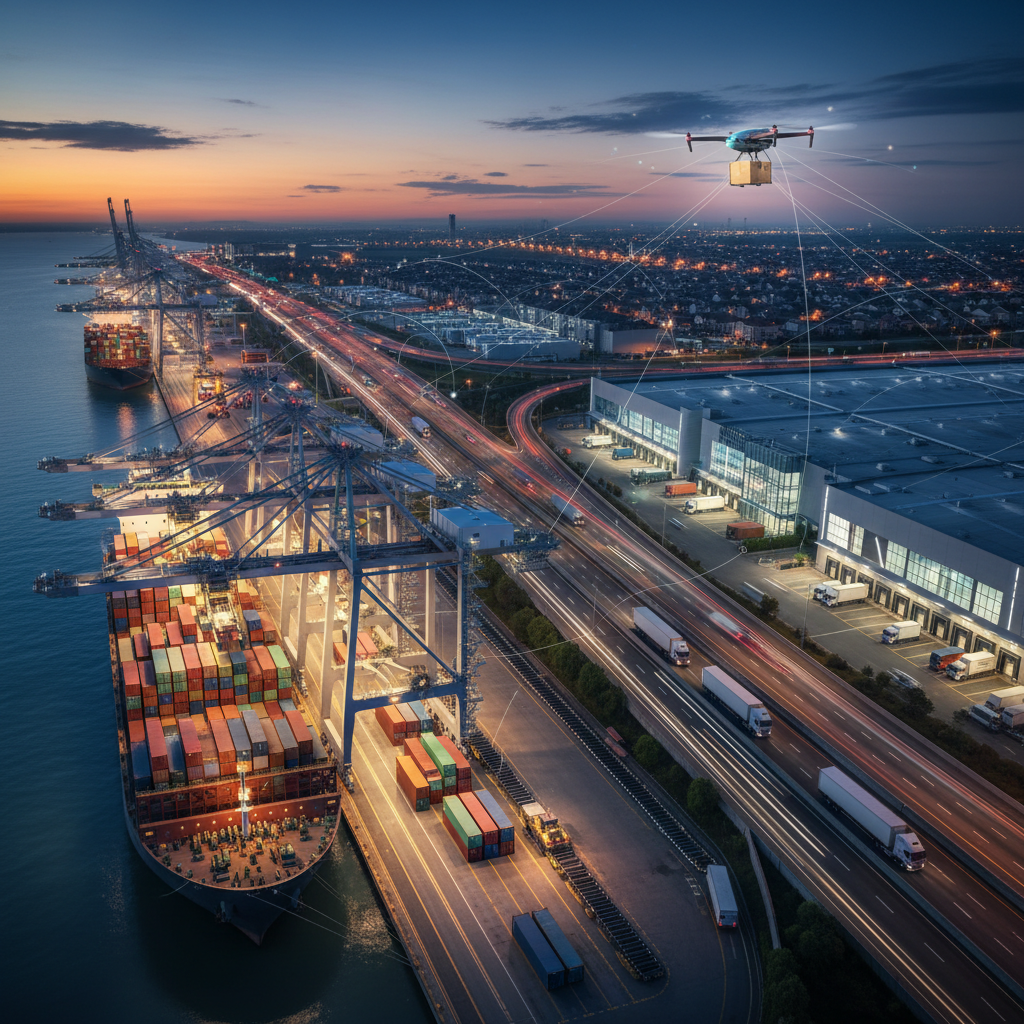
The global supply chain, under immense pressure, requires more than just a network of connections. The real challenge lies in the often-independent management of critical functions like transportation, warehousing, fulfillment, yard and dock operations, and last-mile delivery. These disparate components, along with technology, partners, and people, must coalesce to deliver a single, coherent customer outcome. When they don't, the consequences ripple across global trade.
How this impacts the global supply chain
The fragmentation inherent in managing logistics as a collection of isolated functions profoundly impacts the fluidity and efficiency of global supply chains. Firstly, it creates significant friction in flows. A shipment might be on time from a vessel but then bottlenecked at a port due to uncoordinated yard operations or onward transport, leading to unpredictable lead times. Proactive adjustments are difficult.
Secondly, operational silos compromise the optimization of routes. Individual providers often prioritize their specific operational efficiencies, neglecting the end-to-end journey. This limits dynamic rerouting in response to disruptions like congestion or adverse weather, forcing reliance on rigid pathways.
Thirdly, independent management of functions leads to inefficient capacity utilization. Warehouses may be underutilized while transport assets wait, or vice versa. Yard operations suffer congestion from misaligned inbound scheduling. This wastes valuable resources—from storage space and equipment to labor—driving up costs and reducing overall throughput.
Finally, the cumulative effect on operations is a pervasive lack of agility and responsiveness. Problems originating in one function, like a last-mile delay, are often discovered late, after impacting the customer. This necessitates costly expediting and manual interventions, rather than strategic, coordinated management. For global supply chains, where distances are vast and handoffs numerous, these inefficiencies are magnified, eroding reliability and increasing operational risk.
Global financial impact
The financial repercussions of managing logistics as a series of disconnected functions are substantial, affecting shippers, carriers, and the broader landscape of global trade. For shippers, the primary impact is a significant escalation in operational costs. The unpredictability stemming from fragmented logistics demands higher safety stock levels, tying up capital. Demurrage and detention charges accrue rapidly from uncoordinated yard operations. Expediting fees become a common expense. Beyond direct costs, missed deliveries damage customer relationships and brand reputation, impacting long-term revenue. Administrative overhead also increases from managing disparate systems.
Carriers also bear a heavy financial burden. Waiting times at congested docks or warehouses translate directly into wasted fuel and driver hours, reducing asset utilization. Inefficient route planning, often due to limited downstream visibility, leads to suboptimal asset deployment and empty backhauls, impacting profitability. Lack of integrated data also hinders accurate demand forecasting.
For trade at large, these inefficiencies contribute to higher overall logistics costs, ultimately passed on to consumers. Reduced predictability and reliability of supply chains can deter international investment, hindering economic growth by making cross-border trade riskier. A global trade environment where goods move slowly, unpredictably, and expensively is less competitive and less resilient to shocks, impacting the economic health of nations and the stability of global markets.
How MGS can help navigate today's global trade environment
The fundamental challenge identified—the independent management of various logistics functions preventing a unified customer outcome—is precisely what a shipment-visibility control tower like MGS is designed to address. MGS provides the essential connective tissue that transforms a collection of disparate operations into a cohesive, intelligent system.
At its core, MGS delivers unified, real-time visibility across the entire supply chain. It aggregates data from all critical touchpoints: transportation (across all modes), warehousing, fulfillment centers, yard and dock operations, and last-mile delivery. This breaks down the information silos that plague traditional logistics, offering a single, comprehensive source of truth for every shipment's status and location, from origin to final destination.
This end-to-end visibility empowers proactive coordination and decision-making. Instead of reacting to problems after they occur, MGS enables teams to anticipate and mitigate potential disruptions. For example, if a vessel carrying critical components is delayed, the MGS platform can immediately alert the relevant warehousing teams, yard operators, and last-mile delivery partners. This allows them to adjust staffing levels, reschedule inbound appointments, or even pre-arrange alternative transport options before the shipment arrives, minimizing dwell times and preventing cascading delays.
Furthermore, MGS enhances operational predictability. By continuously monitoring all stages of a shipment's journey against planned schedules, it can highlight deviations and provide estimated times of arrival with greater accuracy. This improved predictability is invaluable for managing customer expectations, optimizing inventory levels, and ensuring that resources are available precisely when needed. It moves organizations from a reactive, crisis-management mode to a proactive, exception-based management approach.
Finally, MGS facilitates seamless integration with partners. In a global supply chain, numerous third parties are involved. By providing a common platform for real-time shipment data, MGS fosters better collaboration with carriers, 3PLs, customs brokers, and other logistics partners. This shared understanding reduces communication overhead, minimizes disputes over shipment status, and aligns all stakeholders towards the common goal of a successful customer outcome. This integrated approach ensures that the "network" truly functions as a single, interdependent system, rather than a series of disconnected links.
Demand–supply analysis & improvement
The independent management of logistics functions directly contributes to a significant disconnect between demand signals and supply execution. When transportation, warehousing, and fulfillment operate in silos, the nuanced requirements of customer demand are often lost or misinterpreted. This leads to misalignments where supply capabilities are not adequately scaled or positioned to meet fluctuating demand, resulting in either excess inventory and carrying costs, or stockouts and lost sales. The failure to "combine to produce one customer outcome" intrinsically points to a breakdown in translating market demand into effective supply chain responses.
To improve this dynamic, integrated planning and real-time data sharing are paramount. Instead of separate forecasts for each function, a unified demand plan needs to inform all logistics operations. For example, a surge in e-commerce orders should immediately trigger coordinated actions across warehousing, yard operations, and last-mile delivery.
A shipment-visibility control tower like MGS serves as a critical enabler for this improvement. By providing a consolidated view of inventory in transit, warehouse capacity, and transport availability, MGS can highlight potential demand-supply mismatches in real-time. If an MGS platform shows an impending surge of inbound goods conflicting with current warehouse capacity or outbound delivery schedules, it allows operators to proactively adjust. This could involve re-prioritizing certain shipments, diverting goods to alternative facilities, or adjusting last-mile delivery schedules. It essentially acts as an early warning system, optimizing resource allocation based on evolving demand.
ROI-focused resilience
The fragmented nature of logistics, where functions are "independently managed," inherently reduces the resilience of the entire supply chain. A disruption in one siloed component can easily cascade, creating widespread delays and cost overruns because there is no overarching mechanism for coordinated response. The quantified risk here is not just the cost of a single delay, but the exponential financial impact of systemic failures: prolonged operational downtime, significant demurrage and detention charges, emergency expediting expenses, and ultimately, substantial revenue loss from unfulfilled orders and eroded customer loyalty.
Investing in solutions that foster integration and end-to-end visibility, such as a control tower platform, directly translates into ROI-driven resilience. The investment in MGS, for instance, protects against these quantified risks by enabling proactive risk mitigation and faster recovery. By providing a real-time, consolidated view of all logistics functions, MGS allows organizations to identify potential disruptions early—whether it's a carrier delay, a customs hold, or an issue at a distribution center.
The ROI is realized through several channels:
- Reduced Costs of Disruption: By enabling proactive rerouting or alternative arrangements, MGS can significantly cut down on emergency expediting costs, demurrage, and detention fees. For example, a 10% reduction in average demurrage costs due to improved yard management and coordination, facilitated by MGS, directly impacts the bottom line.
- Optimized Inventory & Working Capital: Enhanced predictability of inbound and outbound flows reduces the need for excessive safety stock, freeing up working capital. A 5% reduction in inventory holding costs due to more reliable lead times represents a direct financial gain.
- Improved Customer Retention & Revenue: More reliable and predictable deliveries lead to higher customer satisfaction, reducing churn and potentially increasing repeat business. Quantifying this, a 2% increase in customer retention due to improved delivery performance, directly linked to MGS's visibility, offers a clear financial benefit.
- Faster Recovery: In the face of unavoidable disruptions, MGS provides the data and insights necessary to orchestrate a rapid, coordinated recovery, minimizing the duration and financial impact of the event. This might mean reducing recovery time from a major incident by 20%, saving significant operational costs and preventing further revenue loss.
In essence, the investment in integrating logistics functions via a platform like MGS is not merely an operational upgrade; it's a strategic financial decision that quantifiably fortifies the supply chain against inherent risks, turning potential losses into cost savings and competitive advantages.
Source: Logistics Viewpoints — https://logisticsviewpoints.com/2026/09/03/stop-managing-logistics-as-a-collection-of-functions/