
API-First TMS Integration: Why Shippers Are Retiring Legacy EDI
Shippers are shifting carrier connectivity from EDI to API-first TMS integration, cutting onboarding from months to days while keeping audit-critical records intact.
The wave of TMS vendor consolidation reshaping the market in 2025 — acquisitions worth hundreds of millions of dollars, market leaders absorbing niche specialists — has put a spotlight on a question procurement teams had been deferring: how tightly is our carrier connectivity coupled to the platform we might need to leave? For European shippers operating under hard regulatory deadlines, that question has become urgent, and the answer increasingly determines whether a transport technology strategy is resilient or fragile.
The Implementation Time Gap Nobody Talks About
EDI integrations for carrier connectivity have historically taken months to complete. Mapping custom X12 or EDIFACT segments, testing acknowledgement loops, negotiating with IT departments on both sides — the process is well understood precisely because it is painfully slow. API-first integrations can compress this from months to days or weeks. The difference is architectural: REST APIs with documented schemas allow developers to iterate against sandbox environments without waiting for a trading partner's batch processing schedule.
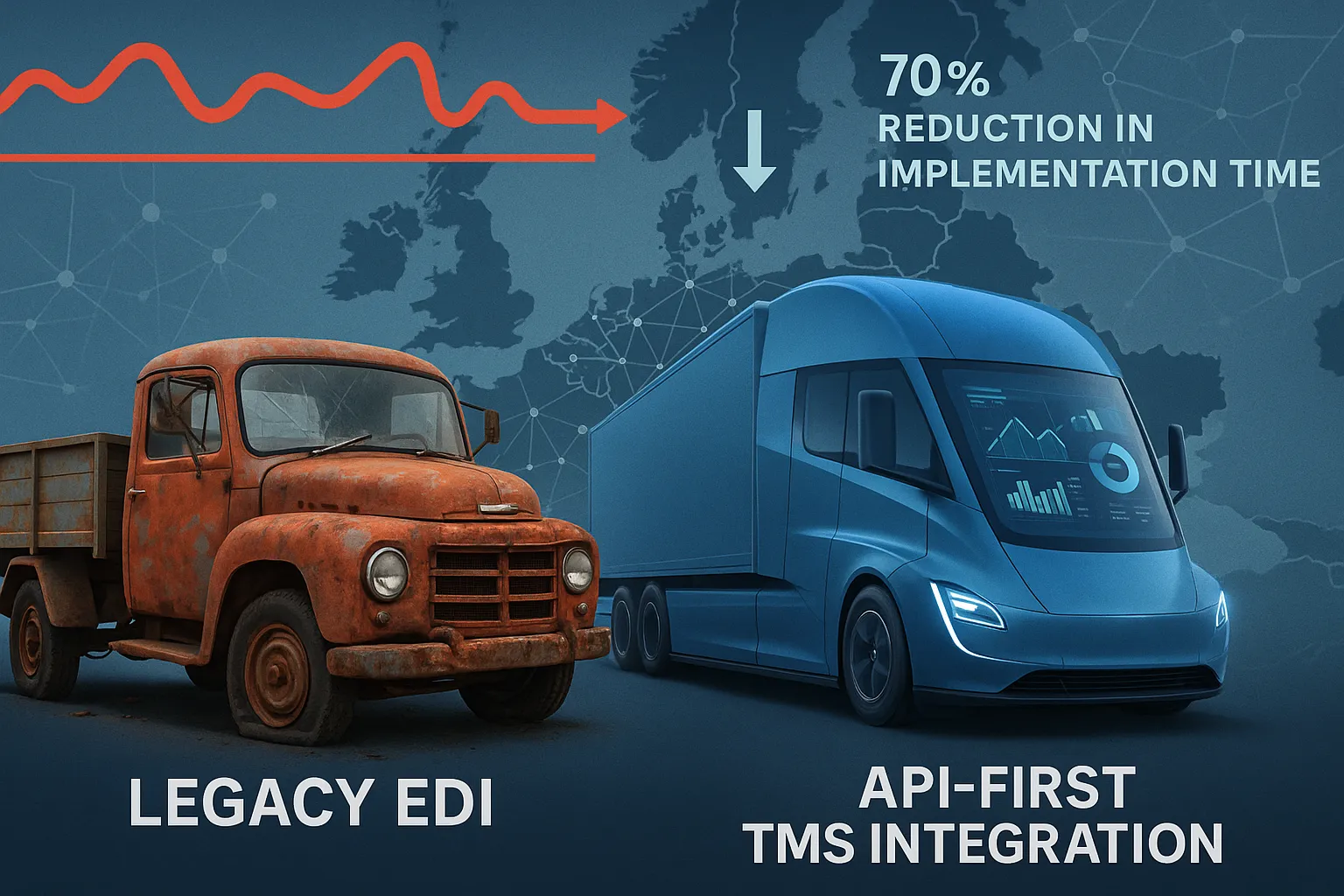
For manufacturers running significant transport operations, that 70% reduction in implementation time is not a feature comparison point — it is the margin between meeting a regulatory deadline and missing it. The EU's eFTI Regulation reaches full application in mid-2027, and ICS2 version 3 messaging became mandatory in early 2026. Both require real-time, structured data exchange that EDI architectures handle awkwardly at best. Procurement teams focused on feature comparisons rather than implementation speed are evaluating the wrong variable.
Why Vendor Lock-In Risk Is Higher Than It Looks
The consolidation wave that saw WiseTech Global acquire E2open and Descartes absorb 3GTMS did more than reduce the competitive field. It changed the risk profile of every remaining independent TMS vendor. Procurement teams that evaluated options two years ago against a competitive landscape may now find that the market has narrowed considerably.
An API-first integration architecture creates a degree of insulation against this risk. When carrier connections are maintained through documented, versioned APIs rather than custom EDI mappings maintained by a specific vendor, the cost and complexity of migrating to a different TMS drops substantially. The carrier connectivity layer becomes portable rather than embedded. This portability is not theoretical — it is the practical difference between a migration that takes weeks and one that takes quarters.
What Consolidation-Resistant Architecture Actually Looks Like
Building for consolidation resistance means separating three concerns that legacy TMS implementations often bundle together: carrier communication protocols, business logic around shipment management, and reporting and visibility outputs.
On the carrier communication side, this means preferring carriers and logistics networks that expose RESTful APIs — and maintaining those integrations in a layer that is explicitly decoupled from whichever TMS sits on top. A middleware layer, or an integration platform, owns the API relationships. The TMS receives normalized, structured data rather than raw carrier responses.
On the business logic side, keeping transport rules, routing logic, and SLA definitions in portable formats — configuration files, documented rule sets — rather than buried in vendor-specific workflow builders makes migration feasible. Audit trails need to be exportable and meaningful without vendor tooling. Teams that can demonstrate a clean separation between carrier connectivity and TMS logic have architectural flexibility that those who cannot simply do not.
The Regulatory Clock Is Not Waiting for Your IT Roadmap
Regulatory deadlines operate on fixed calendars. eFTI, ICS2, and related digital documentation requirements do not adjust for IT project delays. For transport teams that are currently dependent on EDI-based TMS integrations, the practical question is not whether to move toward API connectivity, but how quickly that migration can be completed without disrupting day-to-day operations.
Running parallel systems — maintaining EDI connections for existing carrier relationships while standing up API connections for new ones — is a transitional approach that many teams are taking. The key discipline is avoiding a situation where EDI and API connectivity remain permanently parallel, as the operational overhead of managing both grows over time and the technical debt of maintaining aging EDI mappings compounds with each carrier rate card or schema update.
Audit Records During Transition
One concern that procurement and compliance teams raise consistently is audit continuity. Changing integration architecture during a period of active regulatory change creates a risk that transaction records become fragmented across systems. The transition plan needs to explicitly address how historical EDI transaction records are preserved and queryable alongside new API-generated records.
For customs and compliance purposes, the ability to reconstruct a complete shipment history — regardless of which integration method was used at the time — is non-negotiable. This argues for a data layer that abstracts over the integration method, storing normalized shipment records that can be queried without reference to whether the underlying transport message was an X12 204 or a REST POST.
What This Means in Practice
For shippers and 3PLs managing carrier relationships across multiple modes and geographies, the shift toward API-first integration is less a technology choice than a structural response to market conditions. Regulatory requirements are demanding structured data exchange. Vendor consolidation is increasing the cost of lock-in. API connectivity is the architecture that gives operations teams the flexibility to adapt without rebuilding from scratch each time the vendor landscape changes.
Platforms designed around multi-carrier API connectivity — maintaining normalized milestone data regardless of which carrier reported it and which protocol they used — sit in a stronger position as both the regulatory and vendor landscapes continue to evolve. The integration layer is where operational resilience is built, long before any specific carrier relationship or TMS contract comes up for renewal.
Source: Transport Management Blog